I have just re-purposed my Tumblr blog with a focus on Danish writers and artists, and started translating little pieces of prose and poetry for that. This work pleases me a good deal, and who knows what collections it might lead to...
The work involves finding cool Danish, or - in a pinch - Scandinavian birthdays, and every now and then I stumble over a name that is vaguely familiar, but which I can't quite place. This happened yesterday when I was researching the March 15 birthdays. "Anna Castberg? Who was she, again?"
Well, as it turns out, Anna Castberg is mainly remembered in Denmark for a moment of infamy when she was caught lying on her resumé for the job as Museum Director at the recently built Arken museum - a lovely edifice on the coast just outside Copenhagen, which specializes in Contemporary art.
Ms Castberg was pre-eminently qualified for the job as Director with her PhD in Art History and extensive museum experience, and she was hired in 1993 to build up the collection and launch the new museum in 1996.
Soon, however, the Danish newspapers took a keen interest in the budgets for the new museum which seemed rather out of control, and a bit of digging soon revealed that Castberg didn't really have a degree of any sorts and didn't actually attend any of the universities she claimed to have gone to. She also hadn't really worked for the institutions she had listed on her resumé as prior experience. This was not a new pattern, in fact. When looking for work in Britain, she claimed to have a Danish degree, and vice versa...
She did manage to stick around to launch the museum, which soon became an attractive destination for culture tourism and started putting itself on the map in art circles. However, a few months after the opening she was let go, and promptly vanished from the public view... She seems to have moved back to Britain, and is currently listed as a practicing psychotherapist. I'm not sure she has any formal degree or training as such in that field, either - but hey, that has never stopped her before...
At least two Danish novels and one play have been inspired by the Anna
Castberg affair. I haven't read or seen any of them, but you can easily
find them if you can read Danish. Look for Leif Davidsen's Lime's Billede, or Ole Hyltoft's Mordet på Museet...
So, why am I blogging about Anna Castberg, you might ask... Well, apart from her bold behavior, which I can't help but admire, having worked myself in a business where fraud is rampant but rarely this flamboyant, she did have one true item on her CV that I am particularly interested in.
Cue Leslie-Ann Beldamme, the little-known English folk-singer who at the age of 17 got a contract with Decca and recorded a lovely 7" single with the songs "The One I Love" (R.E.M. were not that original...) as the B-side and "The Rose of Loneliness" as the A-side. Leslie-Ann was of course none other than Holbæk-born Anna Castberg.
At this point in time only the B-side - which according to the label was penned by Leslie-Ann herself, but who knows? - is available on YouTube. I have not heard the A-side which is credited to Mikis Theodorakis, and
titled in parenthesis "Sirtaki song", which would indicate it used the
melody from the film, Zorba the Greek that was a huge hit in 1964. The other
writing credit on that track is for "Jeffery" - maybe an English lyricist? This track also has an arranger credit to Reg Guest (known for his work with The Walker Brothers, Dusty Springfield, and others).
I advise you to listen to "The One I Love" - it is really lovely and very much of its time what with Judy Collins and Joni Mitchell beginning to make a mark for themselves. The vocals are pure, somewhat vibrato-laden, and the melody is simple but catchy in its arrangement for acoustic guitar, bass, a touch of vibraphone and tastefully wire-brushed drums...
I suppose Decca thought - with some justification - they might have
found a true English rose to rival the Americans in this fledgling
market for folky, female singer-songwriters...
However, the single flopped pretty badly, selling only 9.000 copies, and Leslie-Ann never seems to have recorded again - at least not under that name. There is something very endearing about the whole construction of this young girl - the obvious, but clumsy allegorical last name (riffing on the French "Belle Dame" - 'beautiful lady' and her step-father's real name, Beldam), and the both demure and sexy picture of the brunette on the sleeve.
Image engineering was not as blatant in the 1960s as it later became in the music industry and commercial realms - but it certainly did exist. Also, one cannot help but think what would have happened, had Leslie-Ann become the next singing sensation for Decca. Would she still have ended up a fraud, infamous in an entire nation? Or would she have ended up as revered as the late, great Sandy Denny, born one year before Ms Castberg??
The Decca single is available on Discogs and other re-sell sites for a pretty hefty price - 50 GBP on eBay, or €150 on Discogs.
Recently I've begun translating poetry again. This current spate comes 10 years after the last slew of translations I published on this blog in 2009. Seems like yesterday...
Today's poems are all translated from Danish, and they represent three generations of writers - with poems appearing originally in the 1920s, '50s and '80s...
The first poem is by Nis Petersen - from Nattens Pibere, his debut collection from 1926. The strange title refers to the bats he observed and and heard squeaking at night in a local cemetery.
The poem I chose for translation, "When the Cherry Trees Are Blooming", is a witchy celebration of nature's temptations. I don't usually do rhyme-driven poems, but I had a lot of fun with this one.
Nis Petersen was a somewhat tragic figure, who spent many wasted years in his youth, drinking and living as a vagabond because he couldn't hold down a job. He traveled extensively and spent substantial time in Ireland and the Faroe Islands - both locations inspiring poems and novels. His main fame comes from his 1931 historical novel, Sandalmagernes Gade, which is set in classical Rome.
He eventually settled down in the middle of Jutland and stopped drinking after a rehab stay in Sweden. However, his life was cut short by cancer and he died before turning 50, on March 9, 1943...
The second poet I've been working with turns 91 today. Knud Sørensen is a local poet residing on Mors, the island just across from National Park Thy, where I am currently living. Before retiring 35 years ago, Knud Sørensen worked as a surveyor alongside his writing work, and the sense of place and spirit of the land is acute in his writing. He had his debut as a poet in the classic Danish poetry journal, Hvedekorn (Grains of Wheat) which is still going strong.
Below is one of his early Hvedekorn poems, “Morning”, which I have recently translated…
The final translation I'm presenting today is from the work of the
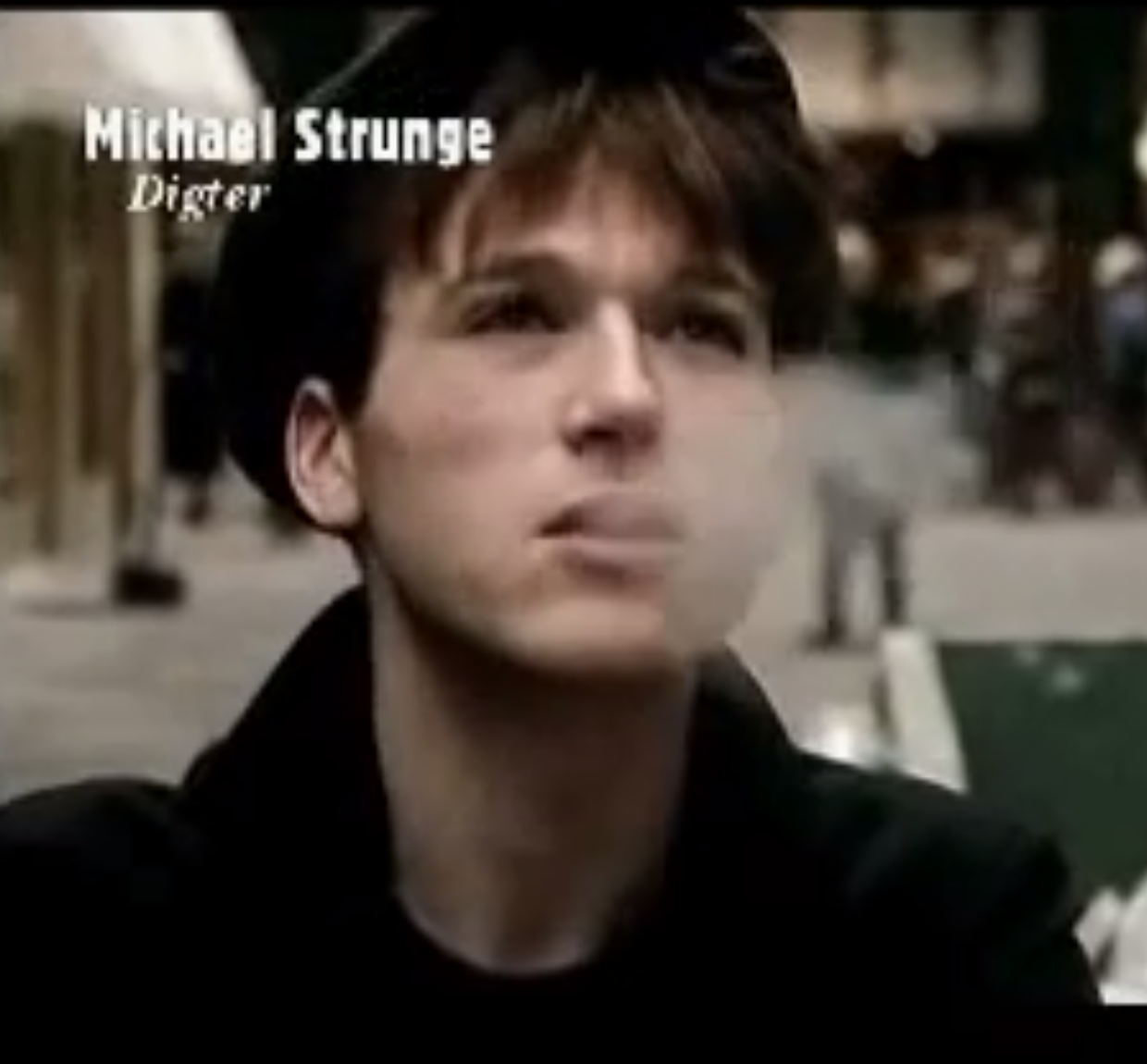
quintessential New Wave post-punk poetic voice in Denmark, Michael Strunge, who died by suicide on March 9, 1986.
Posthumously, Strunge became the most popular poet in Denmark since Klaus Rifbjerg - and in contrast to the two first poets I've mentioned, Strunge was very much an urban voice in Danish poetry. Here is my new translation of his 1984 poem, "When we're asleep" from his collection Armed with Wings...
Note how in the poem the voice of the speaker originates from an apartment in the city and ends up encompassing all of the surrounding landscape. Strunge is far from the first poet to compare the hearts of lovers to a pair of birds - in fact Nis Petersen did exactly that in one of the poems in Nattens Pibere, where he wrote:
"Men tænk, om to mennesker vågnede midt
om natten og glemte, hvad mit var og dit
og sang — bare sang som hr. Kvirrevit
og fru Kvirrevit
kvirrevit!
vit!"
"Imagine two humans waking up one night,
Forgetting what was mine and what was yours
and sang — just sang like Mr. Chip-Chirip
and Mrs. Chip-Chirip:
Chip-chirip!
Chip!"
I'm not suggesting a direct intertextuality between the two misfit poets here, but for sure a commonality of theme and imagery.
As far as I can tell none of these Danish poets from three different generations have been translated into English before. I hope some will enjoy their work.
In late 1954, Russian-Jewish-American composer Alex North was putting the finishing touches to his score for a prison drama - a distinct type of B-movie fodder - titled Unchained. If you’ve seen the film, it’s probably because you’re either an insomniac addicted to the TCM channel, or because you’re a die-hard Dexter Gordon fan who has to have heard every performance he ever laid down. Gordon was, purely by co-incidence, serving a sentence for drug possession when the movie was shot on location in the California Institution for Men, a correctional facility in Chino, and he makes an uncredited cameo appearance as a saxophone player in the prison band.
This 1955 movie is one of those weird instances where a Hollywood script is based on a non-fiction book that tries to offer a corrective to the way mainstream America perceives a social problem - in this case the issue of incarceration and re-socialization of criminal offenders. Hall Bartlett, who started out as a documentary film maker, wrote the screenplay (spending six months living with inmates in a prison while writing it), and was both director and producer as well. He was clearly a man with a conscience and a message. He went on to direct better-known films such as Jonathan Livingston Seagull.
Bartlett was happy enough with North’s score to the movie, but reminded him that there needed to be a song in there as well. After all he had cast African-American operatic baritone Todd Duncan (the original Porgy in Gershwin’s opera Porgy and Bess) in the flick, and he had to have a song to sing. North had a melody in mind, and called up his Tin Pan Alley lyricist Hy Zaret to get him to pen some lyrics. Zaret was pissed off, because he had made plans to paint his house that day and couldn’t be bothered to churn out another set of trifling lyrics. North cajoled him into it after all, and the result was a song without a title, that we all now know as “Unchained Melody”. Heard outside the context of the prison setting that it was performed in in the film, it in fact sounds like any other love song
from the dominant middle-class culture of the 1950s. The lyrics seem unconnected to the theme of the film, and the word “unchained” does not appear in the lyrics anywhere.
Bartlett was a bit miffed that Zaret’s lyrics didn’t spell out the social message, but the way Todd Duncan sang the song by turning it into a Lead Belly style blues/worksong manages to convey the right feeling of longing for freedom that brought the song in alignment with the sentiment of the film: “Long all you want, but don’t break out of jail before you’ve served your time!” In Duncan’s version we suddenly hear the word “time” in a different sense - that of doing hard time in prison, when he sings the lines “Time goes by so slowly, and time can do so much”… The effect is deepened by the blue, dropping glissando Duncan adds to the word “slowly”. In contrast he refrains from glissando on the word “love”, thus shifting the whole dynamics of the lyrics. Remarkably Duncan does not perform the song’s minor key bridge, which in all subsequent versions is a striking feature, enhancing the eerie mood of the song.
Duncan’s abbreviated version, accompanied only by acoustic guitar, lasts little more than a minute on screen, but still the song got an Academy Award nomination and almost won an Oscar. Harry Belafonte recorded a folky version of the song, retaining the simple guitar accompaniment, and also performed it live at the Awards show in 1956, but in the end it was pipped for the Oscar by Love Is a Many-Splendored Thing - incidentally another product created by a Jewish-American Tin Pan Alley song-writer. However, the vision of a black man longing for freedom from shackles and chains resonated in a much deeper way with black performers than even the Unchained film-maker had envisioned, and before the year of release of the film was over two very distinct black vocalists had hits with their versions of the song: Roy Hamilton and Al Hibbler. Both these performers have interesting trajectories in show business and in Hibbler’s case also in civil rights activism, as does a third performer who 5 years later recorded a version of Unchained Melody - Sam Cooke, whose posthumously released 1964 song “A Change Gonna Come” is one of the Civil Rights Era’s classic anthems and comprises the same theme of longing for escape and redemption.
Belafonte's folk version above; Sam Cooke's soul version below...
Each of these four black artists’ version of Unchained Melody added a particular subtext to the otherwise banal love song lyrics, but let's look more in depth at Hibbler's and Hamilton's. Al Hibbler’s version on Decca was officially recorded to tie in with the release of the film, and it owed quite a bit to Duncan’s version in spirit. Hibbler had had a long career as vocalist for Duke Ellington’s big band in the 1940s, and had been struggling to make the transition into solo success as a pop artist in the early 1950s. With Unchained Melody he struck gold. Hibbler was quite the character, often ridiculed for his over the top vocal quirks and idiosyncrasies. He was also a Civil Rights activist as early as the late 1950s which of course made him a problematic commodity as a pop star for record companies. It took the unlikely intervention of Frank Sinatra to ensure that Hibbler could keep recording via a contract with Reprise Records. Hibbler's later career highs include a spirited LP of primarily Ellington material recorded with free jazz horn player Rahsaan Roland Kirk in 1965, but not released till 1972. Perhaps these two, on the surface of things, unlikely collaborators were kindred spirits in more ways than one. Both artists were blind - Hibbler from birth, Kirk from the age of two…
Hibbler’s Unchained Melody is straight-forwardly delivered, with only slight quirks in his dwelling on the word “God” and adding a clear melisma on “to” in the fervently expressed wish in the lyrics “God speed your love to me”. The minor key bridge is rushed in nearly recitativo style, and there are bluesy inflections in phrases such as “Are you still mine?” and on the word “love” - and a vast vibrato effect on the final repetition of the word “me”.
Roy Hamilton recorded his version of Unchained Melody hot on the heels of Hibbler’s and it cashed in almost as well as Hibbler’s ‘official’ release did. Hamilton was a seasoned Gospel artist and he took Unchained Melody to church in ways that Sam Cooke may have listened to and emulated to an extent - not that Cooke hadn’t perfected the transition from gospel to secular music in his own career already. Hamilton recorded for Columbia Records' ‘pop label’, Epic, one of Decca’s main competitors in the multiple genres Unchained Melody participated in - easy listening, gospel, pop, r&b and country. Hamilton’s ace in the hole, vocally, was that he had a voice that could tackle the operatic scale of songs such as Unchained Melody, as well as the earthier qualities vocalists such as Duncan and Hibbler mastered really well. Hamilton’s golden period had started with his hit recording of You’ll Never Walk Alone, and in his eager search for follow-up material, he had stumbled over Unchained Melody. After a brief career in the spotlight, Hamilton ran into health issues (possibly TB) that led to retirement from performances. After several half-successful attempts at comebacks, he died in 1969 from a sudden aneurism in the brain and has lapsed into relative obscurity among music fans.
Hamilton’s nasalised baritone is fuller than Hibbler’s, and Hamilton’s lyrics inflections are on words such as “need” and “touch”, rather than “time”. His use of melisma on “slowly” and vibrato on “love” pull the version out of jail, as it were. This aspect of the song was later exploited more fully when The Righteous Brothers’ Bobby Hatfield recorded what most people consider the definitive version of Unchained Melody in 1965. Hamilton’s musical arrangement at first follows Hibbler’s closely in the use of bugles, but later deviates considerably by adding mysterious string effects to the arrangement of the bridge, where the strings emulate the pull of the waters mentioned in the lyrics. At the end a grand piano emerges from the arrangement and lends a clear gospel tinge to the closing.
The point of this small account of the under-documented early African-American history of “Unchained Melody” is to highlight the versatile Americanness of this song. It throws light on binaries that run through American cultural and identity history, but are often denied or directly debunked. Tin Pan Alley’s greatest song-writers were Jewish-Americans, their songs were often best interpreted by African-American performers who added their own meanings to songs about longings and hardships - and yet the relations between Jewish- and African-Americans were often fraught with racism and stereotypes on both sides. In this particular case, we have a song that was reclaimed by black performers as a text speaking to their shared experience of chains and confinement - despite the fact that the song was not written by an African-American its lyrics and melancholia spoke directly to that part of black identity. However, no sooner was the song reclaimed for black identity, than it was re-appropriated for the white teen market and thoroughly whitewashed by mainstream performers.
Most of the material of the “Great American Songbook” was created by first or second generation immigrants, who worked hard to fit in and realize their American Dream - a Dream that black Americans were debarred from for several decades longer than most other minority groups. Much of the musical material that was recorded and made popular by African-American performers was also quickly re-recorded by white artists, often with more commercial success than the originals. This is obviously also the case with Unchained Melody. Contemporary with Hibbler and Hamilton’s versions, several whitewashed version circulated with great success, including a largely instrumental one by Liberace, a full orchestral and choral arrangement by Les Baxter’s Orchestra, and a strange bolero-tempo version by June Valli which reverses the gender dynamics of the song.
No success with Unchained Melody, however, has been greater than the one scored by Bobby Hatfield in 1965. His arrangement of the song scrubs it completely of its origins as a black man’s prison lament. It’s a white-bread love song by then. The musical changes to the arrangement and the unusual original structure of the song made in The Righteous Brothers’ version contribute to mainstreaming the song into a jukebox hit about teenage love. Hatfield uses excessive melisma on almost every word from the first line of the song, and adds vocal contortions and vibrato to the chorus and to the minor key bridge. He even puts a glissando from the word “me” over into an added “yeah” at the end of the bridge. The pathos of the song is underscored by the march tempo used by the orchestra, and the swelling effect of adding more and more instruments and a choral accompaniment after the bridge.
For the nostalgia market, this version of the song was used in one of the ultimate 1990s love stories, the Patrick Swayze/Demi Moore movie about unattainable love after death, Ghost, sealing the Hatfield version’s evergreen status. The duo also re-recorded the song and for a few weeks bizarrely had two versions of the same song in the US charts. Coincidentally, another use of Unchained Melody in a movie soundtrack occurred the same year when the 1963 novelty/ white doo-wop version by Vito & the Salutations was featured in the gangster movie, Goodfellas… These recontextualizations of Unchained Melody removed the song from its original meaning, and made its cultural expression more universal, but also much less specific - and completed its whitewashing.
Elvis Presley, who had whitewashed a fair bit of black material in his younger days, was a late-comer to Unchained Melody, but managed to record it immediately before his death. His version paradoxically brought back some of the gospel elements Hatfield had taken out, which is especially audible in Elvis’ live TV-version of the song from Cleveland Auditorium in 1977. The footage is strangely ghostly, as an overweight and obviously ill Presley huffs and puffs his way to the piano, only to belt his soul out when the song starts. Once again Unchained Melody becomes associated with impending death in the listener’s mind. Presley brings in much the same orchestral arrangement as The Righteous Brothers’ used, but his use of grand piano takes us right back to Roy Hamilton’s gospel elements, and Elvis’ hiccup at the end of the word “God” (on two separate occasions, so clearly by design) is very reminiscent of Hibbler’s vocal tic at the same point in the lyrics. By odd coincidence, Elvis had met Hamilton shortly before Hamilton’s death in 1969, while they were both recording in the same Memphis studio, both being produced by Chips Moman. Elvis was a long-time fan of Hamilton, particularly his gospel recordings. When Elvis finally tackled Unchained Melody 8 years later he, in a manner of speaking, synthesized the versions that had come before and fused black and white vocal influences together in an all-American version of the song.
However, Unchained Melody never could become reclaimed as black again, despite Elvis, and despite the 100s of versions recorded later. This story is in no way atypical of how music was disseminated and consumed in the US in the 1950s, 60s and 70s where radio play, sales distribution and audiences were still to a large extent racially divided. It’s still remarkable that the early black recordings of Unchained Melody all had cross-over appeal and were enjoyed also by white audiences, and still the song ended up so whitewashed that few now know the African-American portion of its history.
known knowns – what we know that we know – memory
unknown knowns – what we don’t know that we know – forgetfulness
known unknowns – what we know that we don’t know – foresight
unknown unknowns – what we don’t know that we know nothing of – bliss
During the long hiatus this blog has had I have mainly worked with a different type of blogging on a Tumblr platform. Under the title Ordinary Finds(originally intended as a companion to this blog's self-professed 'rarer finds') I have produced close to 5.000 posts - most of them visual rather than text-driven - mentioning important cultural figures from the fields of literature, art, film, music etc.
However, I have frequently experienced language problems when trying to disseminate knowledge about poets who didn't write in English and therefore have had their reputation in Anglophone countries largely depend on the quality of the translations of their work. Routinely I've come across language hampered by old-fashioned formulations, stiff meters, or melodramatic metaphors when looking for good versions of German Romantics or French Modernists alike. As a result I started producing my own translations for posting on Ordinary Finds and its more recent off-shoot Lumpy Pudding- whenever I felt that I was able to improve on the already existing work, or in extreme cases when nothing at all was at hand in English...
I thought that now I would take the opportunity to collect the work of this kind I've done more or less casually over the last 6 to 8 months. Here are seven of my translations from German, French and Romanian. The poets in question are Friedrich Hölderlin, Rainer Maria Rilke, Wolfgang Borchert, Lucian Blaga, Boris Vian and Hector de Saint-Denys Garneau...
~~~~~~~~~~~~~~
Recently my translation of one of Hölderlin’s best short poems, Hälfte des Lebens, was reprinted in the Stanford University program for their fifth Pan-Asian Music Festival - the occasion being the performance of Joji Yuasa’s setting of the poem for chorus and orchestra, entitled Cosmic Solitude… This event illustrates the importance of Hölderlin still: Japanese music, German Romantic poetry translated into English by a Dane, performed by a bunch of ‘Californians’ - good, no?
Hölderlin: One Half of Life
Hung with golden pears
and full of wild roses
is the land in the sea.
Your stately swans,
drunk with kisses,
dunk their heads
in the holy, sobering water.
Alas, where shall I take, when
winter comes, flowers,
sunshine,
and shades of the Earth?
The walls stand,
speechless and cold, in the wind
the banners rattle
.
.
Image - Markus Lüpertz: Ritter Hölderlin und Heine im Schwertkampf - Oil on canvas (The UBS Art Collection)
~~~~~~
Next, I felt the need to tackle Rilke's Herbsttag, which has been translated numerous times by high-level American poets - with quite miserable results. A web page conveniently gathers all the bad ones here...
.
.
Here's my take:
Harvest Day
Lord: it is time. The summer has been huge.
Lay your shadows across the sun dials,
in the fields let the winds run loose.
Command the last fruit to ripen;
give it two more Southern days,
force it to completion and chase
its last sweetness into the heavy wine
He who still has no house shall never build.
He who is alone shall be given short shrift,
shall read and write long letters, shift
and restlessly pace the lanes that skirt the field
watching as the leaves drift.
~~~~~~
I knew little about Wolfgang Borchert before encountering his birthday, but after a little reading I began to admire his political stance as well as his writings. I chose one of his simple poems to translate, but on Ordinary Finds I also posted a mini-bio and an excerpt from his anti-war manifesto, Then There Is Only One Thing To Do...
.
.
Wolfgang Borchert: Try to
Stand in the middle of the rain,
Believe in the blessing of the drops,
Cover yourself in its noise
And try to be good!
Stand in the middle of the wind,
Believe in it and be a child -
Let the storm enter you
And try to be good!
Stand in the middle of the fire -
Love this monster
With the red wine of your heart
And try to be good!
~~~~~~~
Shifting to Romanian poetry, which of course I have been introduced to chiefly by my wife Camelia (who many years ago gave me a trilingual edition of Blaga - which did not have English versions in it!), I quickly ran into problems whenever I wanted to research well-known Romantic or Modernist poets, since they were hardly ever translated into English - or if they were the translations were horrible...
Lucian Blaga was a particular favourite of mine, so I had to do two poems of his, one for OFand one for Lumpy:
.
Quietude
It is so silent all around me that I can hear
the moonbeams when they strike the windows.
Inside me
a stranger’s voice has come awake
singing of a longing that is not mine.
They say that those who died before their time long ago
with young blood in their veins,
with strong passion in their blood,
with strong sunlight in their passion,
will come,
come and live on
in us
those unlived lives.
It is so silent all around me that I can hear
the moonbeams when they strike the windows.
Ah, who knows in whose breast – once, in eternity
you, my soul, will play
on the soft strings of silence,
on the harp of darkness –
a choked-off song of longing and desire to live? Who knows, who knows?
~~~
The Light
The light I feel
streaming in my breast when I see you,
is that not a drop of the light
created on the first day,
that light which thirsts for life?
Nothingness lay dying,
as the impenetrable one, hovering alone in the dark,
gave a sign:
Let there be light!
An ocean
and a raging storm of light
arose in an instant:
a thirst for sins, desires, longings, passions
a thirst for light and sun.
But where did it go, that blinding
first light – who knows?
The light I feel
streaming in my breast when I see you – wondrous one,
may be the last drop
of the light made on that first day.
~~~~~~
While Camelia could certainly help me with the Romanian language (and I am grateful that she did), since it is her mother tongue - and while I have a pretty good command of German myself, the thought of translating from French (a language I have a somewhat troubled relation with) seemed utter lunacy... Still, it wasn't hard to see that a lot of the poetry I was interested in posting could use a bit of a face-lift, and I often managed with the help of pre-existing versions to streamline the texts I enjoyed...
I don’t want to croak
Without having known
The black dogs of Mexico
Who sleep without dreams
The monkeys with bare bums
Devourers of the tropics
The silver spiders
With nests stuffed with bubbles
I don’t want to croak
Without knowing if the moon
Under her false nickel-face
Has a pointed side
If the sun is cold
If the four seasons
Are really only four
Without having tried
Wearing a dress
On the grand boulevards
Without having looked
Into a sewer inspection-hole
Without having put my prick
Into some bizarre corners
I don’t want to end
Without knowing leprosy
Or the seven maladies
One catches down there
The good or the bad
None of them bother me
If if if I knew
That I would have the first of it
And there is also
All that I know
All that I value
That I know pleases me
The green depth of the sea
Where the strands of algae waltz
On the rippled sand
The baked grass of June
The crackling earth
The scent of the pines
And her kisses
Now here, now there
Her beauty obvious to all
My Bear cub, Ursula
I don’t want to croak
Before having used
Her mouth with my mouth
Her body with my hands
The rest with my eyes
I say no more, it’s better
To stay reverential
I don’t want to die
Before someone has invented
Eternal roses
The two hour work-day
The sea at the mountain-side
The mountain at the sea-side
The end of sadness
Newspapers in colour
All children happy
And so many gadgets still
Asleep within the skulls
Of genial engineers
Of jovial gardeners
Of civil citizens
Of urbane urbanites
And thoughtful thinkers
So many things to see
To see and to hear
So much time to spend
Searching in the dark
As for me I see the swarming
End arriving
With his lousy mug
Opening for me his
Bandy toad arms
I don’t want to croak
No Sir, no Ma’am
Before having explored
The flavour which torments me
The flavour which is the heaviest
I don’t want to croak
Before having tasted
The flavour of death.
On the morning of June 23, 1959, Boris Vian was at the Cinema Marbeuf for the screening of the film version of his novel J’irai cracher sur vos tombes. He had already fought with the producers over their interpretation of his work and he publicly denounced the film stating that he wished to have his name removed from the credits. A few minutes after the film began, he reportedly blurted out: “These guys are supposed to be American? My ass!” He then collapsed into his seat and died from sudden cardiac death en route to the hospital.
~~~~~~~
Finally, my latest find, Hector Saint-Denys Garneau, the French-Canadian Modernist who died tragically young, and who seems to anticipate this fate in one of his poems:
.
.
Hector de Saint-Denys Garneau: Bird Cage
I am a bird cage
A cage of bone
With a bird
The bird in the cage of bone
Is death building his nest
When nothing is happening
One can hear him ruffle his wings
And when one has laughed a lot
If one suddenly stops
One can hear him cooing
Deep down
Like a small bell
It is a bird held captive
Death in my cage of bone
Wouldn’t he like to fly away
Are you holding him back
Am I
What is it
He cannot fly away
Until he has eaten all
My heart
The source of blood
With its life inside
June 4, 2009 a fabulously rare first edition of the James Joyce novel Ulysses sold for £275,000, the highest price recorded for a 20th-century first edition. This first edition is unopened – apart from the last episode, where Molly Bloom’s long stream-of-consciousness soliloquy ends in her orgasmic “yes I said yes I will Yes”. The copy is number 45 of the first 100 and is printed on fine Dutch handmade paper. It was originally at the subversive Manhattan bookshop Sunwise Turn, an eclectic shop where patrons could also pick up Peruvian fabrics or the mystic teachings of Gurdjieff. It was bought by a Mrs Hewitt Morgan and then passed down the family, stored in its original box, unopened and away from the light. (Source)
The pleasure of the labyrinth depends on one’s ability to risk everything to make it through, trust one’s instincts, find joy on the wall of the cul-de-sac during the interim as much as that of the secret rune uncovered in the structure’s center, haft of the double-ax. Keeping a journal, diary, log, notebook is much like navigating one’s way through the labyrinth, turning the new blank page as if turning a corner. I get word today from Bent that Pepys finally abandoned his journal on this day, May 31, 340 years ago, basing his reason on loss of sight. He records a final revel with friends at a pub called The World’s End, & rightly compares closing the diary for good with descending into the final underground chamber of the grave itself.
Sunday, May 31, 2009
Burroughs events and book, Naked Lunch@50, ready to float...
William Burroughs at his writing machine, New York, fall 1953. One of numerous, rarely seen photographs taken by Allen Ginsberg that feature in a special Gallery section of Naked Lunch@50, here Ginsberg’s Kodak Retina records a crucial moment for Burroughs, as he worked on the manuscripts of “Queer” and “Yage” before heading off towards Tangier and the writing of Naked Lunch… (Courtesy of the Allen Ginsberg Trust and Stanford University Library.)
Every now and then I do a web search to see if any new images of Jack Kerouac have popped up. Mostly what you get are the usual suspects, well-known images that get re-posted over and over again, but every so often new sources go public with stuff they have been sitting on for decades. This post is an opportunity to gather some of these new photo resources together...
The most exciting new series I have found consists of four portrait shots, done by Tom Palumbo, who for many years did fashion photography for Vogue and Harper's Bazaar as well as celebrity work. He later became a theatre director and was affiliated with Actor's Studio. He is now 86 or 87 and has apparently decided to have someone create a Flickr photostream for him, and to have a nice website showing much of his best work....
Some time in 1955 Palumbo did a session in New York City in a painter's studio on E. 13th Street. Kerouac looks quite aggressive and macho in the resulting shots, perhaps because he was hungry, as Palumbo notes in a caption that the painter cooked up some spaghetti for them to eat after the shoot was wrapped up... Some of the images came up on the web in connection with a Vanity Fair article by Joyce Johnson, posted last August in connection with the 50th anniversary of the US publication of On the Road. The three images below come from Palumbo's photostream:
Don't Mess with Jack Kerouac is Palumbo's caption...
Speaking of Joyce Johnson's Vanity Fair article, this piece also has some quite unusual colour photographs of Kerouac and her, apparently taken at night in New York City. One shows Kerouac leaning against a lamp-post with Joyce in the background (she is out of focus, so you need to know it's her to identify her), another has Kerouac squatting in front of the lamp-post (Joyce is not in this picture at all) with a busy luminous background of neon signs and moving cars...
Joyce was Kerouac's girlfriend at the time when On the Road first appeared and she went with Kerouac to buy the newspapers and read the first reviews of the novel in the early editions on the day of the novel's release. It would be nice to think the photo set was shot on that occasion, but I doubt that was really the case. Joyce went on to write a memoir about her life with Jack, called Minor Characters (1983), and she has also written a play based on letters exchanged between herself and Kerouac.
The photos below were taken by Jerome Yulsman for Globe Photos, Inc., and cannot be dated more precisely than late 1950s (post 1957, pre-break-up with Joyce):
Joyce describes in her article how Kerouac was ill-prepared for the fame and the attendent media frenzy that came with On the Road's success. Kerouac eventually sought refuge on the West Coast and during one of his stays with Carolyn Cassady, the wife of Neal Cassady (the hero of On the Road) and occasional lover of Kerouac, she took a serene snapshot of Kerouac in an easy chair, reading. Note the unlaced, but not discarded hiking boots. Kerouac was, as ever, ready for that 'one fast move and I'm gone'...
While actually whipping On the Road into what the publishers thought was an acceptable shape Kerouac lived a few months in Orlando, Florida. The house he lived in is now a writers' retreat where one can stay as a writer in residence for a few months. After On the Road came out a local photographer did some work for a piece in Time Magazine on the newly famous resident. One very nice shot has surfaced on the web, showing Kerouac among oranges on the back steps of the house with a cat on his lap.
Jack Kerouac on steps at Clouser St.: Orange County Regional History Center, from images by Orlando photographer Fred DeWitt.
Another rarely seen Orlando picture shows Jack with his suitcase, getting ready to leave his sister and brother-in-law's house after a 1959 visit. Note the caption in Swedish in the upper right-hand corner of the image. This may be a photo taken in connection with the collaboration Kerouac did with photographer Robert Frank on a book called simply The Americans...
As Kerouac grew more and more weary of his role as King of the Beats, his alcoholism deepened. Not surprisingly many of the sixties photos of Jack show him in bars or other public places, often clearly intoxicated.
One such picture, Bert Glinn's photo for Magnum, shows Kerouac partying among the folkies at the 7 Arts Café in Greenwich Village, 1959:
A similar picture, but of rather more cultural interest, shows Kerouac with a group of close friends at an undisclosed New York diner. The group features Allen Ginsberg, far right; Greg Corso, who is only represented via the back of his head; David Amram, who has his mouth open (Amram is a musician who frequently collaborated w. Kerouac and who was involved in the film project Pull My Daisy); and - most interestingly - New York School painter and poet, Larry Rivers, seen in profile, wearing a suit (as the only one present)...
This photo, and several others from the same day (in connection with the shooting of the film Pull My Daisy) was taken by John Cohen (who also took the famous 1959 shot of Kerouac listening to himself on the radio)...
But, let's close on a note of up-beat youth and bucolic idyl, with Walter Lehrman's amazing picture of a radiant, yet pensive Jack, anticipating his summer as a fire lookout in the Cascades, 1956:
A few months ago I started keeping a Tumblr log where I post pictures and texts that I find interesting - no particular agenda, no particularly explicit aesthetics. It is a strangely addictive activity - much more so than regular blogging, in fact... I am long since past 600 posts on the Tumblr.
Among the many pictures I have posted is one taken by Eve Arnold, a highly respected Magnum photographer, showing Marilyn Monroe reading a bound edition of James Joyce's Ulysses. The photo is more than 50 years old and there is a respectable amount of scholarship on the image, both from within Joyce-studies (the best is probably Richard Brown's essay in Joyce and Popular Culture, "Marilyn Reading Ulysses: Goddess or Post-Cultural Cyborg?" ) and from the wider field of cultural studies (see Thomas Rasmussen's design studies essay, or Kim Q. Hall's disability studies essay from 2002 in NWSA Journal, which comments on an art-work inspired by the photo, Barbara Bloom's piece Playboy in Braille). My own interest stems from my work on Monroe as an American icon, and let's face it, it is interesting to see an icon read a canonical work of literature! Not least when an (over)eroticized icon reads a notoriously 'dirty' book... All this, however, has been well covered by scholarship as well as more popular accounts (such as the recent book Women Seeing Women: A Pictorial History of Women's Photography from Julia Margaret Cameron to Annie Leibovitz; or the latest issue of Poets & Writers Magazine - blogged about here) over the last 15 years.
The connection that made me post the image was that in 2006 the English newspaper, The Guardian, had asked authors to choose their favourite image of a woman reading, and Jeanette Winterson had picked the Arnold photo. Winterson writes:
This is so sexy, precisely because it’s Marilyn reading James Joyce’s Ulysses. She doesn’t have to pose, we don’t even need to see her face, what comes off the photo is absolute concentration, and nothing is sexier than absolute concentration. There she is, the goddess, not needing to please her audience or her man, just living inside the book. The vulnerability is there, but also something we don’t often see in the blonde bombshell; a sense of belonging to herself. It’s not some playboy combination of brains and boobs that is so perfect about this picture; it is that reading is always a private act, is intimate, is lover’s talk, is a place of whispers and sighs, unregulated and usually unobserved. We are the voyeurs, it’s true, but what we’re spying on is not a moment of body, but a moment of mind. For once, we’re not being asked to look at Marilyn, we’re being given a chance to look inside her.
Arnold in fact was quite friendly with Marilyn and took many pictures of her over a number of years, including several rather private images from the home on Long Island Monroe shared with her then husband, playwright Arthur Miller. Arnold also tells all sorts of candid anecdotes about Marilyn and her balancing a vulnerable personality with a larger than life public persona (see this lovely review of Arnold's book Film Journal in New Statesman, and another in The Guardian).
A few weeks ago I added a site meter to my Tumblr, just out of curiosity as to whether anyone at all was reading my stuff. I advise against doing this - stats are also horribly addictive and you begin to wonder who these people are that keep returning to your site from Mountain View, California or Portugal, Armenia or Malaysia... Shortly after adding my site meter I had a red letter day in my stats, featuring almost 400 unique visitors on one day. This was pretty flabbergasting, and I tried to figure out why and what these people were looking for or at. I soon discovered that my Marilyn post had been 'found' by one of the main users of StumbleUpon, the well-known web bookmarks-sharing site. Her write-up seemed to generate 85-90 % of the traffic on my Tumblr as referrals almost all came from there...
So far, so good - however the StumbleUpon thing was already a couple of weeks old when I got the peak traffic, and over the next two weeks I have had other peaks of 300+ visits, sometimes even on a Tuesday. I can only conclude that people are dying to see Marilyn, and that when they have seen this sexy picture of her they all tell their friends in Kansas, Wisconsin, Malaysia, Armenia and other outposts of civilization to go see it too. There haven't been any new reviews of the Marilyn post on StumbleUpon for a couple of weeks, so I don't know exactly what drives them - not novelty, anyway...
I am, of course, happy that people want to visit my Tumblr, but I realize that this bubble will never last. And I am less happy that out of 600+ posts, the Marilyn one gets all the attention. But that's life...
Never having been one to shy away from whoring for attention, I have tried to post other good Marilyn pictures on the Tumblr - to no avail since they have not been picked up - sorry, 'stumbled upon' - by one of the star endorsers on the top 24 of full-time nerds who do nothing but stumble around the web. I actually rather think I would like to become one such myself, time allowing...
Anyhoo, knowing that almost no-one reads this blog I have decided to go for more attention by publishing no less than 3 Eve Arnold photos of Marilyn in one post. One never knows how many lonely college boys from Missoula, Montana that might attract...
All day I have been preoccupied with translation, and I have very much had Nick Drake's Pink Moon album on my mind. As many will undoubtedly know, the public fame of that album and its title song grew exponentially when VW decided to use it in one of their commercials, targeted specifically at an anti-commercial-watching segment of potential VW-buyers...
A long chapter of the 33 1/3-series volume on Pink Moon by Amanda Petrusich is given over to a very full description of the creative and commercial process behind the making of this particular ad, so one can go there for additonal info.
This, not very successful book carries a very pretentious blurb, part of which goes like this:
Like nearly all prematurely buried cult figures, Nick Drake is reinvented each time he is rediscovered. In 2000, the sheepish, astral musings of "Pink Moon" became synonymous with backing a Volkswagen Cabrio convertible away from a raucous house party, as VW boldly sold American drivers on the notion of eschewing red plastic cups and bro-hugs for moonbeams and tree trunks (and a cute German car - sort of). The Cabrio ad inadvertently sparked an unlikely boost in record sales, propelling the album towards platinum status nearly 28 years after its release. But with each well-intentioned revival of interest, Nick Drake slips further and further out of reach, martyred and codified, superceded and consumed by his own tragic context. Since his controversial death in 1974, Nick Drake has become: the 26-year-old prophet, the diffident enigma, the tortured precursor to Kurt Cobain, the fallen hero, the folksinger-as-folksymbol, the self-sacrificing patron saint of lonely, disaffected teenagers - the One who died for our sins.
For now, just watch:
Note how the commercial contrasts nature and a quiet communion with it (river, darkness, fireflies - and, of course - moon) with youth culture of the noisy, imbecilic kind (loutish, drunken and disorderly behaviour). This is a tricky sell: one community has to be valorized (we are not interested in lonely drivers here); the other must be connoted negatively. A strategy that helps accomplish this is to associate the essential features of the car with the desired community and its harmony with nature. The car's stream-lined design details and its almost noiseless swoosh as it glides through the land all become natural features: the tail lights are at one with other light sources: fireflies, moon glow; the in-car stereo produces harmonious sounds that only enhance nature's singing (crickets), and do not drown them out. The price for this is that the commercial has to conjure up a fantasy world: after all one cannot really listen to acoustic folk music in most cars, least of all with the top down!
The actual lyrics to Drake's song are, of course, not really very suited for the purpose of selling a cabriolet car - or any product for that matter, with the possible exception of Prozac. They are in fact quite scary and haunting, promising us that forces of nature will catch up with 'you', the addressee of the song, i.e. us all, and do away with us:
I saw it written and I saw it say
Pink moon is on its way
And none of you stand so tall
Pink moon gonna get you all
It's a pink moon
It's a pink, pink, pink, pink, pink moon.
The threat, revenge fantasy or prophesy spoken by these lyrics makes a lot of sense in connection with Nick Drake's own life, but clashes violently with the easy life and quest for peace and quiet of the young people riding the VW. The only way this can work is if our four friends in the cabrio can somehow be associated with the pink moon and its revenge on an other, unidentified party. This is accomplished through the film's timing of image and music, with the most aggressive part of the lyrics being sung just as the car pulls up in front of the house where the obnoxious party guests are already at it with their offensive, loutish behaviour. The VW drivers thus become allies with the pink moon in the future eradication of the louts... but for now they'll just drive on through the night, swooshing along to Nick Drake's whispered lyrics.
This use or abuse of a song that is basically a cry for help in order to sell cars has indeed offended many who were already fans of Nick Drake's music. On the flip side of that concern is the unquestionable fact that thousands of people who had never heard this music before began seeking it out because of the commercial. One testimony on YouTube captures the sentiment of several young people encountering Drake's music through the commercial:
I listened to all of Nick's songs, especially this one, when I drove from Atlanta to LA alone in my Alfa spider, the top down much of the way, most beautifully in New Mexico. For me, the commercial makes me yearn for those perfect youthful summers I never quite had, fresh aired freedom with lovely groovy girls and true blue friends and all of life's delicious possibilities rolled out before them. And who cares if it's a commercial. Copywriters and directors can be as soulful as anyone.
In a cultural studies vocabulary, this is the typical process of commodification and incorporation into the mainstream of a hitherto underground, or subcultural artefact or cultural phenomenon. The incorporation always comes at a price, but also opens up a potential space for usage of the product in new narratives, which themselves can still be subversive or un-incorporated...
I just received a pre-notification on a cfp for an event celebrating the 50th anniversary of the publication of William Burroughs' Naked Lunch.
The organisers are Burroughs and Beat Gen. scholar Oliver Harris, in partnership with fellow-Burroughsian - see for instance Reality Studio - Ian MacFadyen (they are also co-editing the book, Naked Lunch@50), and with Andrew Hussey, Dean of the University of London Institute in Paris.
The organizers promise that the event website will be developed shortly, but you can already take a sneak peek here.
The following four streams will organize the discussions:
We welcome proposals that range from short papers (15 minutes) to longer talks (30 minutes), from multi-media presentations to panel discussions and open mic debates. In English and in French, we are looking for original and innovative contributions from scholars and Burroughsians under the headings: The Untold Naked Lunch / A Post-Colonial Lunch / Naked Paris / Naked Lunch Now.
I hope a lot of scholars will gather in Paris next July to discuss and celebrate this extraordinary novel.
Every year the International Literature and Psychology Conference offers scholars an opportunity to discuss literature and the other arts, using insights from psychoanalysis and other psychological approaches. We have psychoanalysts, psychotherapists, Freudians, Lacanians, a few Jungians and myth theorists, Zizek'ers, post-Zizek'ers, plus an assortment of literature and culture scholars who like to dabble in the psychology of narratives and objects. The 25th annual conference took place in Lisbon at Instituto Superior de Psicologia Aplicada, ISPA, and just finished a few days ago.
My paper there had a certain American Studies relevance, as I spoke about recent American post-9/11 fiction as trauma narratives. Here are a few excerpts from that paper:
The post-traumatic aftermath of 9/11 is currently playing itself out in every conceivable arena, generating cultural texts in many different modes and genres: memoirs, documentaries, political analyses, therapeutic discourse, poetry, drama and film, to name but a few. Not surprisingly, given such a plethora of discourses, several novels have also recently appeared which thematize directly the effect of the 9/11 events on individuals, in or outside America. In my paper I propose to analyze these novels as trauma narratives, as well as aesthetic products. I shall focus mainly on Extremely Loud and Incredibly Closeby Jonathan Safran Foer, but I also draw in Don DeLillo’s Falling Man, and, to a lesser extent, Ken Kalfus’ A Disorder Peculiar to the Country.
The 20th century has often been dubbed the century of trauma – hardly surprising given the list of horrendous events occurring as the technology of destruction seemed to outpace the ethical development of the human race. WWI; WWII, featuring genocide in too many forms to number, including the Holocaust and the advent and use of nuclear weapons; Communist mass internments, dislocations and extermination; colonial and post-colonial wars world-wide, but particularly violent in Africa and south-east Asia; assorted minor wars and conflicts, often with a component of ethnic or religious cleansing at their core – the list could go on and does go on as we speak. The truth of the matter seems that the 21st century promises to outdo the previous century in terms of traumatic quantity.
If this had not been painfully obvious to that proportion of the world’s population living in the USA, the events of September 2001 certainly constituted a rude awakening. While the number of lives lost in the attacks on the WTC and the Pentagon was not very high by comparison to war-time events, the exposure of the events by the media and their secondary effects once disseminated and re-disseminated gave us a hitherto unprecedented example of what I would term ‘trauma by proxy’. I personally lived through the aftermath of 9/11 at close proximity in New York City and felt the effects of post-traumatic stress to a nearly career-ending extent, so I do not speak lightly or frivolously of these events – yet one cannot but wonder why such a relatively small-scale occurrence should generate a massive discourse body, large enough to rival that generated by the holocaust or the nuclear and other civil terror warfare strategies of the entire WWII…
I have in fact addressed the specifics of this phenomenon in another piece, so suffice it here to say that an innocent, even naive people’s state of mental unpreparedness, combined with a ruthless exploitation of the initial trauma by the media and a war-hungry political and military establishment has led to an unusual and disproportionately protracted post-traumatic phase in the American public unconscious. Novelists have latterly turned to this rich story for material for tales of trauma and survival, and as is always the case with trauma narratives thereby run the risk of further perpetuating the post-traumatic phase. On the other hand, literature may just have a role to play in healing the trauma, or at least to lend voice to the victims, and therefore we should perhaps turn to an examination of a few post-9/11 novels.
Jonathan Safran Foer was born in 1977 and represents the third generation of postmodern American writers (first wavers include Thomas Pynchon, John Barth and Kurt Vonnegut; second wavers Don DeLillo, Paul Auster and E.L. Doctorow). Foer’s debut novel Everything Is Illuminated tackled contemporary teenage consumer culture and the Eastern European Holocaust/survivor legacy all at once. The result was a funny, infuriating and haunting novel which redefined the trauma narrative genre in its own right. In his 2005 follow-up Extremely Loud and Incredibly Close Foer continues to mix historical narratives in the best tradition of historiographic metafiction as developed by first and second generation postmodern authors such as Pynchon (known for his two-tier novels which construct a nexus between WWII and contemporary America of the 1960s), Vonnegut (same dual strategy in Slaughterhouse 5, with some futuristic sci-fi mixed in), and Auster (whose 1980s novels, such as Leviathan, frequently examined the historical roots of politically motivated terrorism, although they did not feature the explicit two-tier structure Pynchon, Vonnegut and Foer all employ). Foer’s novel constitutes an obvious intertext with the works of all three older writers and with several other practitioners of postmodern narrative (such as Don DeLillo).
The most obvious intertext is Vonnegut’s oeuvre, particularly Slaughterhouse 5, with which Extremely Loud shares the theme of the fire bombings of Dresden, as well as Vonnegut’s later, extensive use of graphic tricks, illustrations and samples of handwritten texts, all of which features are also employed to excess by Foer. Auster haunts Foer’s text in several ways, not least in the implicit (as in never stated) Jewishness of several of the protagonists, but also in the multiple references to walks and rambles in New York, which is strongly reminiscent of scenes in Auster’s New York Trilogy where apparently random rambles literally produce texts and messages (but little meaning). In Extremely Loud the young protagonist Oskar Schell spends a good deal of the novel searching for a lock to match a key he has found among his dead father’s belongings. In the process of this quest he visits every single person in New York named Black (another allusion to Auster whose protagonists are frequently colour-coded). The outcome of the search is however as disappointing as any postmodern quest for epistemological insight (cf. Oedipa Maas in Pynchon’s The Crying of Lot 49) as the lock turns out to have no relation to Oskar’s father’s life at all.
The trauma narrative in Extremely Loud consists in two story tiers each representing a different historical period and its traumatic events. Oskar is traumatised by proxy by the 9/11 terrorist attack, during which his father dies in the WTC collapse. Oskar is the only family member who knows that his father left several phone messages from the WTC tower on the day of his death, and Oskar is plagued by survivor’s guilt, not least because he did not pick up the phone the last time his father called, immediately before the collapse. All Oskar has left are memories of his father and the recordings from the answering machine. He desperately tries to make sense of these texts and clues that remain, but much of the time he is in fugue from the trauma content provided by these memories and texts. He zips up “the sleeping bag of his self” (dissociation), wears “heavy boots” (depression), compulsively counts the seconds until he falls asleep, and is generally incapacitated by his trauma and grief. The search for the lock that the key he finds may open is his last resort at finding a solution to the conundrum of why his father had to die.
Another narrative strand is interspersed, accounting in Oskar’s grandparents’ alternating voices for some of the events in Dresden, before, during and after the British and American fire bombings in February 1945. Oskar’s grandmother (who was not present at that time in Dresden) further listens to a survivor’s account of the atom bomb’s effect on Hiroshima, which lends another layer of historical depth to her and Oskar’s experiences (and allows increased reader horror and empathy). Her husband, Oskar’s grandfather, experiences the bombings first-hand and loses his first love, Anna (the sister of Oskar’s grandmother) who is newly pregnant with his child. As a result he gradually loses the ability to speak, his artistic gift as a sculptor, which it has been his life’s dream to pursue, and in his bitterness and powerlessness he swears never again to have children. He immigrates to America to put as much distance as possible between himself and the scene of his loss.
The two narrative strands meet in the present of post-9/11 New York, but prior to that there is a mediation phase where Oskar’s family history is recounted. Oskar’s grandparents have re-met shortly after WWII and decided to marry, despite their handicaps and the lack of mutual love between them. He is trying to survive despite his oral aphasia and an artist’s block; she is trying to come to terms with the loss of her entire family, and through a complicated system of text production they try to cope with these losses. In both cases, however, the trauma effect erases all possible narratives of itself. He writes thousands of daybooks, filling them with phrases that he needs in everyday communication, but which make little sense outside their specific pragmatic use; she tries to cope with her gradual loss of sight by writing her life story on an old typewriter he provides her with. The story she fills thousands of pages with turns out to be written without a ribbon in the typewriter and therefore no legible traces are left on these many pages. He tries to hide this fact from her by pretending to read and discuss the narrative with her.
This lie on which their relationship rests is mirrored in another deception, as she quickly realises that he still loves her sister and is only using her as a sexual and emotional stand-in for that, to him, all-important person. In effect, he is reliving the traumatic experience of Anna’s loss every day by being married to her sister instead. She decides to be her own person and to follow her destiny instead of performing a tragic repetition of her sister’s life and breaks their agreement to never have children by becoming pregnant. He leaves her the very day she tells him this. After that his writing changes, as he begins a new string of thousands of letters addressed to his son, in which he tries to justify his actions. In the only one of these letters his son ever receives he succeeds in narrating the horror of his Dresden experience. That letter is reproduced in the novel’s diegetic world, complete with the son’s copy editing of the discourse, marked in red as a literal form of trauma redaction.
At the point in time where the two tiers of history and narrative are brought together (post 9/11) Oskar’s grandfather and grandmother have begun living together again. He has brought all of the unsent letters to his son back from Europe and now has no living person to send or read them to. Their son has died a death as meaningless as Anna’s, and he has a hard time finding a way to be present in his grandson’s life. It is only by gradually involving himself in Oskar’s project of visiting the Blacks that he finds a way back in a newly constituted family. The better solution to the trauma of both these generations turns out to lie in another act of textual transmission, and Oskar and his grandfather decide to exhume Oskar’s father’s empty coffin and instead fill it with the letters grandfather never sent. Through this exchange the grandfather purges himself of a burden of guilt, an act of outpouring or kenosis, which then fills the cenotaph or empty grave and by proxy fills some new non-trauma tainted content into Oskar’s life. The trauma is thus worked through to some extent, or at least partially cathected by the confrontation with the void/gap which has led Oskar to a pattern of avoidance behaviour (he invents impossible gadgets that will keep everyone safe, he avoids “obvious targets” of terrorism such as trains and ferries, he collects evidence of “stuff that happened to me” (pictures he downloads from the internet containing victims, crimes, porn etc.)), leaving Oskar and his family with the possibility of forming new attachments in a more anger-free, de-affected, non-addictive manner.
Don DeLillo’s post-9/11 novel, Falling Man, by contrast contains the story of a literal survivor of the WTC collapse, but more importantly also demonstrates the effect by proxy of such a traumatic event on a small family. The strains on the married couple in the narrative are quite similar to the ones described as tearing Oskar’s grandparents apart in Foer’s novel. DeLillo’s protagonist feel equally dissociated from the routines of his actual family who desires nothing more than a continuation of life as it was before the disruption, and eventually he seeks the company of a fellow survivor whom he hopes has the capacity to understand his emotions of anger, depression and suicidal numbness. De Lillo’s novel also draws narrative lines to Germany, but not the Germany of WWII. Instead the protagonist’s mother-in-law has an affair with a former Rote Armé Fraktion terrorist, and another German strand consists of us occasionally sharing the viewpoint of one of the 9/11 terrorists who has been trained partially in a German university and there has been converted to the cause by Mohammad Atta. Falling Man is a collective novel, as almost all its characters are allowed representation and narrative point of view. This causes the novel to be diffuse and uneven, especially as the terrorists (former and present) come across as little more than stunted human beings, stereotyped beyond sympathy. As the main protagonists all suffer from PTSD, one also encounters in their diction the deadening of affect so typical of trauma sufferers (recreated in a virtuoso performance by DeLillo) and this means that the novel is flat and uneventful on a surface level. The book ends with a tour de force scene where for the first time in the novel we enter into the burning tower with the protagonist and witness the traumatic event directly through his eyes. The scene begins onboard the hijacked plane and is narrated from the terrorist’s point of view. The second the plane hits the tower and he dies, the point of view is propelled out of his body and into the protagonist’s physical experience of the explosion. This transition is probably meant to suggest the communality of destiny between victim and terrorist, but somehow leaves the reader dissatisfied. DeLillo is in my opinion more culpable of 9/11 exploitation than Foer, despite not providing any cathexis of trauma content for his characters.
DeLillo and Foer of course share the trope of falling as central to the dynamics of their novels. Foer’s protagonist Oscar wishes to know how his father died and imagines that he can see him in the grainy news footage of people jumping from the burning tower. In the end he invents a mechanism that can play back the events in his head in reverse, and the novel closes with a series of images of a man falling up toward safety which can be activated by flicking the pages of the book in the manner of a primitive animation (an oblique reference to E.L. Doctorow’s Ragtime). DeLillo’s falling man is a body artist who enacts a body falling towards the ground in a number of public settings in New York, much in the manner of what Yves Klein, the French situationist performer, painter and photographer did in real life.
In the novel the New Yorkers are angry with this artist who reminds them of an event many would rather repress the memory of thoroughly. However, the protagonist’s wife comprehends the necessity of the artist acting out the trauma content and mourns him when he dies as a result perhaps of a re-enactment going wrong. Thus DeLillo illustrates well the function of art as a solution to the ill effects of trauma-by-proxy which might otherwise be contributing to the trauma content being perpetuated unnecessarily. Nonetheless, ultimately one does not need DeLillo’s novel to the extent that one needs Foer’s. Both authors have renounced their frequently employed satirical repertoire and in the case of DeLillo this leaves him with little else to offer.




 Every now and then I do a web search to see if any new images of Jack Kerouac have popped up. Mostly what you get are the usual suspects, well-known images that get re-posted over and over again, but every so often new sources go public with stuff they have been sitting on for decades. This post is an opportunity to gather some of these new photo resources together...