Showing posts with label Literature. Show all posts

Thursday, October 28, 2021

Did Jack Kerouac read Miyamoto Musashi's Dokkōdō?

Here is Musashi, in his manifesto for life and practice, Dokkōdō, written in 1645, a week before he died:

The 21 precepts of Dokkōdō:

1. Accept everything just the way it is.

2. Do not seek pleasure for its own sake.

3. Do not, under any circumstances, depend on a partial feeling.

4. Think lightly of yourself and deeply of the world.

5. Be detached from desire your whole life long.

6. Do not regret what you have done.

7. Never be jealous.

8. Never let yourself be saddened by a separation.

9. Resentment and complaint are appropriate neither for oneself or others.

10. Do not let yourself be guided by the feeling of lust or love.

11. In all things have no preferences.

12. Be indifferent to where you live.

13. Do not pursue the taste of good food.

14. Do not hold on to possessions you no longer need.

15. Do not act following customary beliefs.

16. Do not collect weapons or practice with weapons beyond what is useful.

17. Do not fear death.

18. Do not seek to possess either goods or fiefs for your old age.

19. Respect Buddha and the gods without counting on their help.

20. You may abandon your own body but you must preserve your honour.

21. Never stray from the way.


And here is Kerouac, Belief and Technique for Modern Prose, written 1958 and published the year after:

1. Scribbled secret notebooks, and wild typewritten pages, for yr own joy

2. Submissive to everything, open, listening

3. Try never get drunk outside yr own house

4. Be in love with yr life

5. Something that you feel will find its own form

6. Be crazy dumbsaint of the mind

7. Blow as deep as you want to blow

8. Write what you want bottomless from bottom of the mind

9. The unspeakable visions of the individual

10. No time for poetry but exactly what is

11. Visionary tics shivering in the chest

12. In tranced fixation dreaming upon object before you

13. Remove literary, grammatical and syntactical inhibition

14. Like Proust be an old teahead of time

15. Telling the true story of the world in interior monolog

16. The jewel center of interest is the eye within the eye

17. Write in recollection and amazement for yourself

18. Work from pithy middle eye out, swimming in language sea

19. Accept loss forever

20. Believe in the holy contour of life

21. Struggle to sketch the flow that already exists intact in mind

22. Dont think of words when you stop but to see picture better

23. Keep track of every day the date emblazoned in yr morning

24. No fear or shame in the dignity of yr experience, language & knowledge

25. Write for the world to read and see yr exact pictures of it

26. Bookmovie is the movie in words, the visual American form

27. In praise of Character in the Bleak inhuman Loneliness

28. Composing wild, undisciplined, pure, coming in from under, crazier the better

29. You're a Genius all the time

30. Writer-Director of Earthly movies Sponsored & Angeled in Heaven.


Sunday, March 10, 2019

Translating Poetry, 10 Years After

Recently I've begun translating poetry again. This current spate comes 10 years after the last slew of translations I published on this blog in 2009. Seems like yesterday...

Today's poems are all translated from Danish, and they represent three generations of writers - with poems appearing originally in the 1920s, '50s and '80s...

The first poem is by Nis Petersen - from Nattens Pibere, his debut collection from 1926. The strange title refers to the bats he observed and and heard squeaking at night in a local cemetery.


The poem I chose for translation, "When the Cherry Trees Are Blooming", is a witchy celebration of nature's temptations. I don't usually do rhyme-driven poems, but I had a lot of fun with this one.

Nis Petersen was a somewhat tragic figure, who spent many wasted years in his youth, drinking and living as a vagabond because he couldn't hold down a job. He traveled extensively and spent substantial time in Ireland and the Faroe Islands - both locations inspiring poems and novels. His main fame comes from his 1931 historical novel, Sandalmagernes Gade, which is set in classical Rome.

He eventually settled down in the middle of Jutland and stopped drinking after a rehab stay in Sweden. However, his life was cut short by cancer and he died before turning 50, on March 9, 1943...

The second poet I've been working with turns 91 today. Knud Sørensen is a local poet residing on Mors, the island just across from National Park Thy, where I am currently living. Before retiring 35 years ago, Knud Sørensen worked as a surveyor alongside his writing work, and the sense of place and spirit of the land is acute in his writing. He had his debut as a poet in the classic Danish poetry journal, Hvedekorn (Grains of Wheat) which is still going strong.


 Below is one of his early Hvedekorn poems, “Morning”, which I have recently translated…

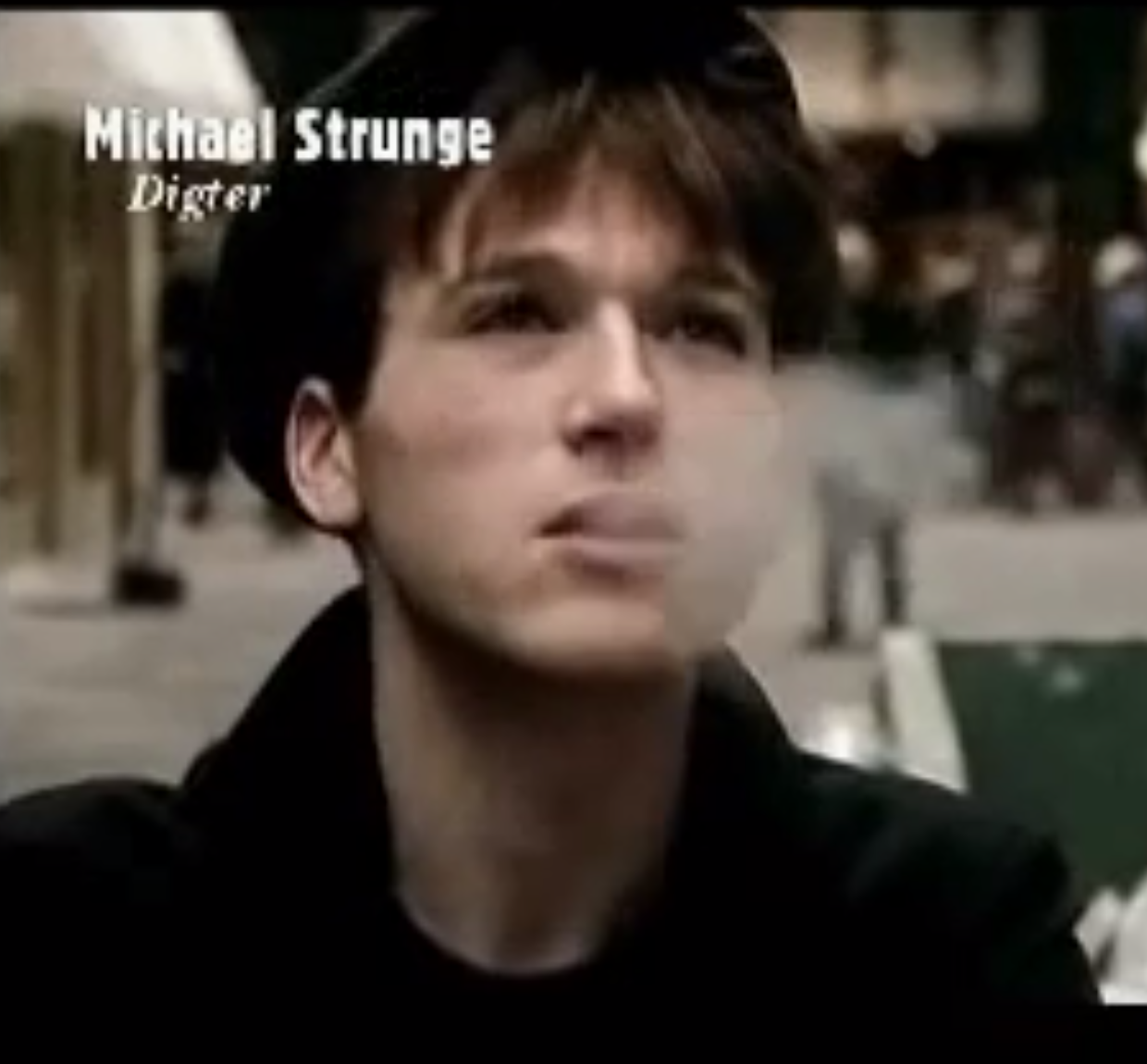
The final translation I'm presenting today is from the work of the quintessential New Wave post-punk poetic voice in Denmark, Michael Strunge, who died by suicide on March 9, 1986.


Posthumously, Strunge became the most popular poet in Denmark since Klaus Rifbjerg - and in contrast to the two first poets I've mentioned, Strunge was very much an urban voice in Danish poetry. Here is my new translation of his 1984 poem, "When we're asleep" from his collection Armed with Wings...


Note how in the poem the voice of the speaker originates from an apartment in the city and ends up encompassing all of the surrounding landscape. Strunge is far from the first poet to compare the hearts of lovers to a pair of birds - in fact Nis Petersen did exactly that in one of the poems in Nattens Pibere, where he wrote:

"Men tænk, om to mennesker vågnede midt
om natten og glemte, hvad mit var og dit
og sang — bare sang som hr. Kvirrevit
og fru Kvirrevit
kvirrevit!
vit!"

"Imagine two humans waking up one night,
Forgetting what was mine and what was yours
and sang — just sang like Mr. Chip-Chirip
and Mrs. Chip-Chirip:
Chip-chirip!
Chip!"

I'm not suggesting a direct intertextuality between the two misfit poets here, but for sure a commonality of theme and imagery.

As far as I can tell none of these Danish poets from three different generations have been translated into English before. I hope some will enjoy their work.

Sunday, June 14, 2009

Forthcoming from the great M. Federman


Seen on Federman's blog....

Tuesday, June 9, 2009

yes I said yes I will Yes

June 4, 2009 a fabulously rare first edition of the James Joyce novel Ulysses sold for £275,000, the highest price recorded for a 20th-century first edition.
This first edition is unopened – apart from the last episode, where Molly Bloom’s long stream-of-consciousness soliloquy ends in her orgasmic “yes I said yes I will Yes”. The copy is number 45 of the first 100 and is printed on fine Dutch handmade paper. It was originally at the subversive Manhattan bookshop Sunwise Turn, an eclectic shop where patrons could also pick up Peruvian fabrics or the mystic teachings of Gurdjieff. It was bought by a Mrs Hewitt Morgan and then passed down the family, stored in its original box, unopened and away from the light. (Source)

Sunday, May 31, 2009

Burroughs events and book, Naked Lunch@50, ready to float...

William Burroughs at his writing machine, New York, fall 1953. One of numerous, rarely seen photographs taken by Allen Ginsberg that feature in a special Gallery section of Naked Lunch@50, here Ginsberg’s Kodak Retina records a crucial moment for Burroughs, as he worked on the manuscripts of “Queer” and “Yage” before heading off towards Tangier and the writing of Naked Lunch… (Courtesy of the Allen Ginsberg Trust and Stanford University Library.)

Sunday, September 28, 2008

What's up with Kerouac lately?

Every now and then I do a web search to see if any new images of Jack Kerouac have popped up. Mostly what you get are the usual suspects, well-known images that get re-posted over and over again, but every so often new sources go public with stuff they have been sitting on for decades. This post is an opportunity to gather some of these new photo resources together...

The most exciting new series I have found consists of four portrait shots, done by Tom Palumbo, who for many years did fashion photography for Vogue and Harper's Bazaar as well as celebrity work. He later became a theatre director and was affiliated with Actor's Studio. He is now 86 or 87 and has apparently decided to have someone create a Flickr photostream for him, and to have a nice website showing much of his best work....

Some time in 1955 Palumbo did a session in New York City in a painter's studio on E. 13th Street. Kerouac looks quite aggressive and macho in the resulting shots, perhaps because he was hungry, as Palumbo notes in a caption that the painter cooked up some spaghetti for them to eat after the shoot was wrapped up... Some of the images came up on the web in connection with a Vanity Fair article by Joyce Johnson, posted last August in connection with the 50th anniversary of the US publication of On the Road. The three images below come from Palumbo's photostream:


Don't Mess with Jack Kerouac is Palumbo's caption...

Speaking of Joyce Johnson's Vanity Fair article, this piece also has some quite unusual colour photographs of Kerouac and her, apparently taken at night in New York City. One shows Kerouac leaning against a lamp-post with Joyce in the background (she is out of focus, so you need to know it's her to identify her), another has Kerouac squatting in front of the lamp-post (Joyce is not in this picture at all) with a busy luminous background of neon signs and moving cars...

Joyce was Kerouac's girlfriend at the time when On the Road first appeared and she went with Kerouac to buy the newspapers and read the first reviews of the novel in the early editions on the day of the novel's release. It would be nice to think the photo set was shot on that occasion, but I doubt that was really the case. Joyce went on to write a memoir about her life with Jack, called Minor Characters (1983), and she has also written a play based on letters exchanged between herself and Kerouac.
The photos below were taken by Jerome Yulsman for Globe Photos, Inc., and cannot be dated more precisely than late 1950s (post 1957, pre-break-up with Joyce):


Joyce describes in her article how Kerouac was ill-prepared for the fame and the attendent media frenzy that came with On the Road's success. Kerouac eventually sought refuge on the West Coast and during one of his stays with Carolyn Cassady, the wife of Neal Cassady (the hero of On the Road) and occasional lover of Kerouac, she took a serene snapshot of Kerouac in an easy chair, reading. Note the unlaced, but not discarded hiking boots. Kerouac was, as ever, ready for that 'one fast move and I'm gone'...


While actually whipping On the Road into what the publishers thought was an acceptable shape Kerouac lived a few months in Orlando, Florida. The house he lived in is now a writers' retreat where one can stay as a writer in residence for a few months. After On the Road came out a local photographer did some work for a piece in Time Magazine on the newly famous resident. One very nice shot has surfaced on the web, showing Kerouac among oranges on the back steps of the house with a cat on his lap.


Jack Kerouac on steps at Clouser St.: Orange County Regional History Center, from images by Orlando photographer Fred DeWitt.

Another rarely seen Orlando picture shows Jack with his suitcase, getting ready to leave his sister and brother-in-law's house after a 1959 visit. Note the caption in Swedish in the upper right-hand corner of the image. This may be a photo taken in connection with the collaboration Kerouac did with photographer Robert Frank on a book called simply The Americans...


As Kerouac grew more and more weary of his role as King of the Beats, his alcoholism deepened. Not surprisingly many of the sixties photos of Jack show him in bars or other public places, often clearly intoxicated.

One such picture, Bert Glinn's photo for Magnum, shows Kerouac partying among the folkies at the 7 Arts Café in Greenwich Village, 1959:


A similar picture, but of rather more cultural interest, shows Kerouac with a group of close friends at an undisclosed New York diner. The group features Allen Ginsberg, far right; Greg Corso, who is only represented via the back of his head; David Amram, who has his mouth open (Amram is a musician who frequently collaborated w. Kerouac and who was involved in the film project Pull My Daisy); and - most interestingly - New York School painter and poet, Larry Rivers, seen in profile, wearing a suit (as the only one present)...


This photo, and several others from the same day (in connection with the shooting of the film Pull My Daisy) was taken by John Cohen (who also took the famous 1959 shot of Kerouac listening to himself on the radio)...

But, let's close on a note of up-beat youth and bucolic idyl, with Walter Lehrman's amazing picture of a radiant, yet pensive Jack, anticipating his summer as a fire lookout in the Cascades, 1956:

Tuesday, July 15, 2008

Naked Lunch at 50

I just received a pre-notification on a cfp for an event celebrating the 50th anniversary of the publication of William Burroughs' Naked Lunch.

The organisers are Burroughs and Beat Gen. scholar Oliver Harris, in partnership with fellow-Burroughsian - see for instance Reality Studio - Ian MacFadyen (they are also co-editing the book, Naked Lunch@50), and with Andrew Hussey, Dean of the University of London Institute in Paris.

The organizers promise that the event website will be developed shortly, but you can already take a sneak peek here.

The following four streams will organize the discussions:

We welcome proposals that range from short papers (15 minutes) to longer talks (30 minutes), from multi-media presentations to panel discussions and open mic debates. In English and in French, we are looking for original and innovative contributions from scholars and Burroughsians under the headings: The Untold Naked Lunch / A Post-Colonial Lunch / Naked Paris / Naked Lunch Now.
I hope a lot of scholars will gather in Paris next July to discuss and celebrate this extraordinary novel.

You are free to download and distribute the flyer for the Symposium. (PDF, 324 kb)

PS: Quick follow-up. Here is a good tie-in article by Jan Herman...

Thursday, July 10, 2008

American post-9/11 fiction

Every year the International Literature and Psychology Conference offers scholars an opportunity to discuss literature and the other arts, using insights from psychoanalysis and other psychological approaches. We have psychoanalysts, psychotherapists, Freudians, Lacanians, a few Jungians and myth theorists, Zizek'ers, post-Zizek'ers, plus an assortment of literature and culture scholars who like to dabble in the psychology of narratives and objects. The 25th annual conference took place in Lisbon at Instituto Superior de Psicologia Aplicada, ISPA, and just finished a few days ago.

My paper there had a certain American Studies relevance, as I spoke about recent American post-9/11 fiction as trauma narratives. Here are a few excerpts from that paper:

The post-traumatic aftermath of 9/11 is currently playing itself out in every conceivable arena, generating cultural texts in many different modes and genres: memoirs, documentaries, political analyses, therapeutic discourse, poetry, drama and film, to name but a few. Not surprisingly, given such a plethora of discourses, several novels have also recently appeared which thematize directly the effect of the 9/11 events on individuals, in or outside America. In my paper I propose to analyze these novels as trauma narratives, as well as aesthetic products. I shall focus mainly on Extremely Loud and Incredibly Close by Jonathan Safran Foer, but I also draw in Don DeLillo’s Falling Man, and, to a lesser extent, Ken Kalfus’ A Disorder Peculiar to the Country.


The 20th century has often been dubbed the century of trauma – hardly surprising given the list of horrendous events occurring as the technology of destruction seemed to outpace the ethical development of the human race. WWI; WWII, featuring genocide in too many forms to number, including the Holocaust and the advent and use of nuclear weapons; Communist mass internments, dislocations and extermination; colonial and post-colonial wars world-wide, but particularly violent in Africa and south-east Asia; assorted minor wars and conflicts, often with a component of ethnic or religious cleansing at their core – the list could go on and does go on as we speak. The truth of the matter seems that the 21st century promises to outdo the previous century in terms of traumatic quantity.

If this had not been painfully obvious to that proportion of the world’s population living in the USA, the events of September 2001 certainly constituted a rude awakening. While the number of lives lost in the attacks on the WTC and the Pentagon was not very high by comparison to war-time events, the exposure of the events by the media and their secondary effects once disseminated and re-disseminated gave us a hitherto unprecedented example of what I would term ‘trauma by proxy’. I personally lived through the aftermath of 9/11 at close proximity in New York City and felt the effects of post-traumatic stress to a nearly career-ending extent, so I do not speak lightly or frivolously of these events – yet one cannot but wonder why such a relatively small-scale occurrence should generate a massive discourse body, large enough to rival that generated by the holocaust or the nuclear and other civil terror warfare strategies of the entire WWII…

I have in fact addressed the specifics of this phenomenon in another piece, so suffice it here to say that an innocent, even naive people’s state of mental unpreparedness, combined with a ruthless exploitation of the initial trauma by the media and a war-hungry political and military establishment has led to an unusual and disproportionately protracted post-traumatic phase in the American public unconscious. Novelists have latterly turned to this rich story for material for tales of trauma and survival, and as is always the case with trauma narratives thereby run the risk of further perpetuating the post-traumatic phase. On the other hand, literature may just have a role to play in healing the trauma, or at least to lend voice to the victims, and therefore we should perhaps turn to an examination of a few post-9/11 novels.

Jonathan Safran Foer was born in 1977 and represents the third generation of postmodern American writers (first wavers include Thomas Pynchon, John Barth and Kurt Vonnegut; second wavers Don DeLillo, Paul Auster and E.L. Doctorow). Foer’s debut novel Everything Is Illuminated tackled contemporary teenage consumer culture and the Eastern European Holocaust/survivor legacy all at once. The result was a funny, infuriating and haunting novel which redefined the trauma narrative genre in its own right. In his 2005 follow-up Extremely Loud and Incredibly Close Foer continues to mix historical narratives in the best tradition of historiographic metafiction as developed by first and second generation postmodern authors such as Pynchon (known for his two-tier novels which construct a nexus between WWII and contemporary America of the 1960s), Vonnegut (same dual strategy in Slaughterhouse 5, with some futuristic sci-fi mixed in), and Auster (whose 1980s novels, such as Leviathan, frequently examined the historical roots of politically motivated terrorism, although they did not feature the explicit two-tier structure Pynchon, Vonnegut and Foer all employ). Foer’s novel constitutes an obvious intertext with the works of all three older writers and with several other practitioners of postmodern narrative (such as Don DeLillo).

The most obvious intertext is Vonnegut’s oeuvre, particularly Slaughterhouse 5, with which Extremely Loud shares the theme of the fire bombings of Dresden, as well as Vonnegut’s later, extensive use of graphic tricks, illustrations and samples of handwritten texts, all of which features are also employed to excess by Foer. Auster haunts Foer’s text in several ways, not least in the implicit (as in never stated) Jewishness of several of the protagonists, but also in the multiple references to walks and rambles in New York, which is strongly reminiscent of scenes in Auster’s New York Trilogy where apparently random rambles literally produce texts and messages (but little meaning). In Extremely Loud the young protagonist Oskar Schell spends a good deal of the novel searching for a lock to match a key he has found among his dead father’s belongings. In the process of this quest he visits every single person in New York named Black (another allusion to Auster whose protagonists are frequently colour-coded). The outcome of the search is however as disappointing as any postmodern quest for epistemological insight (cf. Oedipa Maas in Pynchon’s The Crying of Lot 49) as the lock turns out to have no relation to Oskar’s father’s life at all.

The trauma narrative in Extremely Loud consists in two story tiers each representing a different historical period and its traumatic events. Oskar is traumatised by proxy by the 9/11 terrorist attack, during which his father dies in the WTC collapse. Oskar is the only family member who knows that his father left several phone messages from the WTC tower on the day of his death, and Oskar is plagued by survivor’s guilt, not least because he did not pick up the phone the last time his father called, immediately before the collapse. All Oskar has left are memories of his father and the recordings from the answering machine. He desperately tries to make sense of these texts and clues that remain, but much of the time he is in fugue from the trauma content provided by these memories and texts. He zips up “the sleeping bag of his self” (dissociation), wears “heavy boots” (depression), compulsively counts the seconds until he falls asleep, and is generally incapacitated by his trauma and grief. The search for the lock that the key he finds may open is his last resort at finding a solution to the conundrum of why his father had to die.

Another narrative strand is interspersed, accounting in Oskar’s grandparents’ alternating voices for some of the events in Dresden, before, during and after the British and American fire bombings in February 1945. Oskar’s grandmother (who was not present at that time in Dresden) further listens to a survivor’s account of the atom bomb’s effect on Hiroshima, which lends another layer of historical depth to her and Oskar’s experiences (and allows increased reader horror and empathy). Her husband, Oskar’s grandfather, experiences the bombings first-hand and loses his first love, Anna (the sister of Oskar’s grandmother) who is newly pregnant with his child. As a result he gradually loses the ability to speak, his artistic gift as a sculptor, which it has been his life’s dream to pursue, and in his bitterness and powerlessness he swears never again to have children. He immigrates to America to put as much distance as possible between himself and the scene of his loss.

The two narrative strands meet in the present of post-9/11 New York, but prior to that there is a mediation phase where Oskar’s family history is recounted. Oskar’s grandparents have re-met shortly after WWII and decided to marry, despite their handicaps and the lack of mutual love between them. He is trying to survive despite his oral aphasia and an artist’s block; she is trying to come to terms with the loss of her entire family, and through a complicated system of text production they try to cope with these losses. In both cases, however, the trauma effect erases all possible narratives of itself. He writes thousands of daybooks, filling them with phrases that he needs in everyday communication, but which make little sense outside their specific pragmatic use; she tries to cope with her gradual loss of sight by writing her life story on an old typewriter he provides her with. The story she fills thousands of pages with turns out to be written without a ribbon in the typewriter and therefore no legible traces are left on these many pages. He tries to hide this fact from her by pretending to read and discuss the narrative with her.

This lie on which their relationship rests is mirrored in another deception, as she quickly realises that he still loves her sister and is only using her as a sexual and emotional stand-in for that, to him, all-important person. In effect, he is reliving the traumatic experience of Anna’s loss every day by being married to her sister instead. She decides to be her own person and to follow her destiny instead of performing a tragic repetition of her sister’s life and breaks their agreement to never have children by becoming pregnant. He leaves her the very day she tells him this. After that his writing changes, as he begins a new string of thousands of letters addressed to his son, in which he tries to justify his actions. In the only one of these letters his son ever receives he succeeds in narrating the horror of his Dresden experience. That letter is reproduced in the novel’s diegetic world, complete with the son’s copy editing of the discourse, marked in red as a literal form of trauma redaction.


At the point in time where the two tiers of history and narrative are brought together (post 9/11) Oskar’s grandfather and grandmother have begun living together again. He has brought all of the unsent letters to his son back from Europe and now has no living person to send or read them to. Their son has died a death as meaningless as Anna’s, and he has a hard time finding a way to be present in his grandson’s life. It is only by gradually involving himself in Oskar’s project of visiting the Blacks that he finds a way back in a newly constituted family. The better solution to the trauma of both these generations turns out to lie in another act of textual transmission, and Oskar and his grandfather decide to exhume Oskar’s father’s empty coffin and instead fill it with the letters grandfather never sent. Through this exchange the grandfather purges himself of a burden of guilt, an act of outpouring or kenosis, which then fills the cenotaph or empty grave and by proxy fills some new non-trauma tainted content into Oskar’s life. The trauma is thus worked through to some extent, or at least partially cathected by the confrontation with the void/gap which has led Oskar to a pattern of avoidance behaviour (he invents impossible gadgets that will keep everyone safe, he avoids “obvious targets” of terrorism such as trains and ferries, he collects evidence of “stuff that happened to me” (pictures he downloads from the internet containing victims, crimes, porn etc.)), leaving Oskar and his family with the possibility of forming new attachments in a more anger-free, de-affected, non-addictive manner.


Don DeLillo’s post-9/11 novel, Falling Man, by contrast contains the story of a literal survivor of the WTC collapse, but more importantly also demonstrates the effect by proxy of such a traumatic event on a small family. The strains on the married couple in the narrative are quite similar to the ones described as tearing Oskar’s grandparents apart in Foer’s novel. DeLillo’s protagonist feel equally dissociated from the routines of his actual family who desires nothing more than a continuation of life as it was before the disruption, and eventually he seeks the company of a fellow survivor whom he hopes has the capacity to understand his emotions of anger, depression and suicidal numbness. De Lillo’s novel also draws narrative lines to Germany, but not the Germany of WWII. Instead the protagonist’s mother-in-law has an affair with a former Rote Armé Fraktion terrorist, and another German strand consists of us occasionally sharing the viewpoint of one of the 9/11 terrorists who has been trained partially in a German university and there has been converted to the cause by Mohammad Atta. Falling Man is a collective novel, as almost all its characters are allowed representation and narrative point of view. This causes the novel to be diffuse and uneven, especially as the terrorists (former and present) come across as little more than stunted human beings, stereotyped beyond sympathy. As the main protagonists all suffer from PTSD, one also encounters in their diction the deadening of affect so typical of trauma sufferers (recreated in a virtuoso performance by DeLillo) and this means that the novel is flat and uneventful on a surface level. The book ends with a tour de force scene where for the first time in the novel we enter into the burning tower with the protagonist and witness the traumatic event directly through his eyes. The scene begins onboard the hijacked plane and is narrated from the terrorist’s point of view. The second the plane hits the tower and he dies, the point of view is propelled out of his body and into the protagonist’s physical experience of the explosion. This transition is probably meant to suggest the communality of destiny between victim and terrorist, but somehow leaves the reader dissatisfied. DeLillo is in my opinion more culpable of 9/11 exploitation than Foer, despite not providing any cathexis of trauma content for his characters.

DeLillo and Foer of course share the trope of falling as central to the dynamics of their novels. Foer’s protagonist Oscar wishes to know how his father died and imagines that he can see him in the grainy news footage of people jumping from the burning tower. In the end he invents a mechanism that can play back the events in his head in reverse, and the novel closes with a series of images of a man falling up toward safety which can be activated by flicking the pages of the book in the manner of a primitive animation (an oblique reference to E.L. Doctorow’s Ragtime). DeLillo’s falling man is a body artist who enacts a body falling towards the ground in a number of public settings in New York, much in the manner of what Yves Klein, the French situationist performer, painter and photographer did in real life.


In the novel the New Yorkers are angry with this artist who reminds them of an event many would rather repress the memory of thoroughly. However, the protagonist’s wife comprehends the necessity of the artist acting out the trauma content and mourns him when he dies as a result perhaps of a re-enactment going wrong. Thus DeLillo illustrates well the function of art as a solution to the ill effects of trauma-by-proxy which might otherwise be contributing to the trauma content being perpetuated unnecessarily. Nonetheless, ultimately one does not need DeLillo’s novel to the extent that one needs Foer’s. Both authors have renounced their frequently employed satirical repertoire and in the case of DeLillo this leaves him with little else to offer.
I hope that a longer version of this paper will appear shortly in PsyArt: An Online Journal for the Psychological Study of the Arts.

Monday, May 19, 2008

Back in the thick of it

I still haven't gotten back in a proper routine after the Nordic Americanist events over the last two weeks, but every mill needs its grist, not least the publication one. Therefore it is gratifying to have two new book chapters out as a result of 2006's conference going!

Space Haunting Discourse is a volume out from Cambridge Scholars Press, edited by Maria Holmgreen Troy and Elizabeth Wennö from Karlstad U. Maria and Elizabeth put on two excellent interdisciplinary conferences in 2004 and '06 and I participated in both of them. The chapter I have in the fresh volume is on novels about Big Sur, California by Henry Miller, Jack Kerouac and Richard Brautigan. Maria and Elizabeth have written a comprehensive and generous introduction to the volume which is available as a PDF from the publishers' web site. They give the following description of my piece:

Presence and absence are also features of Bent Sørensen’s “Representations of Big Sur in Late Modernist and Early Postmodernist American Writing.” The textual referent is the actual geographical Californian Big Sur, inscribed with meanings by three writers in such a way that it is rendered absent and instead emphasises loss and disillusion. In effect, his analysis supports David Harvey’s argument that the genius loci, the place of special significance to the individual and the community, “is open to contestation, both theoretically (as to its meaning) and concretely (as to how to understand a place)” (309). Henry Miller, Jack Kerouac and Richard Brautigan all wrote prose about Big Sur, and Sørensen demonstrates how this locus haunts these texts in three significantly diverging ways: Miller’s locus amoenus, Kerouac’s tremens, and Brautigan’s topos.

Within the short span of seven years, the potential of Big Sur as a locus representing ideas and emotions has been transformed into a fully textualised topos, which can only serve as a vehicle for pastiche and postmodern parody of Brautigan’s modernist precursors’ anxieties. His text is haunted by the intertextual ghosts of Kerouac’s and Miller’s gender and racial values, which are parodied by Brautigan’s incongruous collection of beatnik womanisers and exploiters of both land and Native American (and Confederate) heritages. At the end of the essay Sørensen quotes J. Gerald Kennedy’s remarks on the distinction between a subjective concept of place and a “textual, writerly image”: the difference between the two is not a structural one of “real and fictive” but “between textual scenes and the symbolic experiences of place which they inscribe.” Taking it one step further we could say that Sørensen’s analysis of modernist and postmodernist inscriptions also reflect the epistemological shift in theory as well as the shift in literature from the crypto-religious impulse of modernism to the playful linguistic preoccupation of much postmodernism.
My other new book chapter is an analysis of Uncle Sam as an American icon. It is published in a volume edited by Ari Helo of the Helsinki Renvall Institute, titled Communities and Connections: Writings in North American Studies. That chapter will be integrated in my forthcoming book American Icons: Transgression and Commodification.

Friday, April 18, 2008

Nirvana No

Sparked off by some of my recent posts on spirituality and quests for insight in relation to the work of Van Morrison and of the Beats, I have started thinking about some of the conundrums Western artists find themselves in when they become fascinated with Eastern belief systems.

Both Jack Kerouac and Van Morrison have frequently referenced Buddhism in their works (novels, poems, songs) In fact, Kerouac read widely in Buddhist texts over a period of several years, and eventually started composing his own sutras, or contemporary versions of sacred texts. Morrison has, of course, dropped references to both Kerouac's novels and to well-known Western popularizers of Buddhism in several of his songs... One key figure in this gamut is Alan Watts, who was English but lived the better part of his active life as a Buddhist popularizer in the USA (he died in 1973). The author of more than 25 books and avid lecturer and broadcaster, Watts' ideas are still being disseminated in today's media, via posthumous book publications, on discs, DVDs and on the Web... At some point Kerouac met and became friends with Watts, and he appears as a character in two of Kerouac's novel, Desolation Angels (as Alex Aums) and Big Sur (as Arthur Wayne). Morrison primarily glosses Watts' work in a song aptly named "Alan Watts Blues" (on Poetic Champions Compose) where the chorus is a rendition of the title of a Watts book: Cloud-hidden Whereabouts Unknown. The bridge lyrics go like this:

Sittin' up on the mountain-top in my solitude
Where the morning fog comes rollin' in
Just might do me some good.

Such sentiments echo very well with a Beat writer such as Gary Snyder, whose translations of Han Shan's Cold Mountain poems, for instance, sound very similar:

I settled at Cold Mountain long ago,
Already it seems like years and years.
Freely drifting, I prowl the woods and streams
And linger watching things themselves.
Men don't get this far into the mountains,
White clouds gather and billow.
Thin grass does for a mattress,
The blue sky makes a good quilt.
Happy with a stone under head
Let heaven and earth go about their changes.

Clambering up the Cold Mountain path,
The Cold Mountain trail goes on and on:
The long gorge choked with scree and boulders,
The wide creek, the mist blurred grass.
The moss is slippery, though there's been no rain
The pine sings, but there's no wind.
Who can leap the word's ties
And sit with me among the white clouds?

As a result of Watts' acquaintance with the Beats (he first knew Snyder, who was a serious Zen acolyte and also known to D.T. Suzuki, the first scholar to disseminate a knowledge of Buddhism in English) he wrote a fairly well-known essay titled "Beat Zen, Square Zen, and Zen", originally published as a pamphlet by City Lights Books in 1959, then collected and re-published in the Random House essay collection This Is It in 1962. Here are his definitions of the different mind sets to approaching Zen:

Square Zen is a quest for the right spiritual experience, for a satori which will receive the stamp (inka) of approval and established authority. There will even be certificates to hang on the wall. [Whereas f]or beat Zen there must be no effort, no discipline, no artificial striving to attain satori or to be anything but what one is. [He describes its self-defensive underside] But for square Zen there can be no true satori without years of meditation-practice under the stern supervision of a qualified master.

Not only did Watts identify the typical Western approaches to Zen as Beat or Square, respectively - pinpointing these approaches' short-comings (one is not serious enough and seeks instant gratification, the other is more philosophical than spiritual and caters to the intellect rather than the soul...), but in The Joyous Cosmology (1957) he had already offered a more history of ideas founded account of the difficulties of reception of Eastern religion for a Western mind-set:

The practical difficulty is that Taoism and Zen are so involved with the forms of Far Eastern culture that it is a major problem to adapt them to Western needs. For example, Eastern teachers work on the esoteric and aristocratic principle that the student must learn the hard way and find out almost everything for himself. Aside from occasional hints, the teacher merely accepts or rejects the student's attainments. But Western teachers work on the exoteric and democratic principle that everything possible must be done to inform and assist the student so as to make his mastery of the subject as easy as possible. Does the latter approach, as purists insist, merely vulgarize the discipline? The answer is that it depends upon the type of discipline. If everyone learns enough mathematics to master quadratic equations, the attainment will seem small in comparison with the much rarer comprehension of the theory of numbers. But the transformation of consciousness undertaken in Taoism and Zen is more like the correction of faulty perception or the curing of a disease. It is not an acquisitive process of learning more and more facts or greater and greater skills, but rather an unlearning of wrong habits and opinions. As Lao-tzu said, "The scholar gains every day, but the Taoist loses every day."

The practice of Taoism or Zen in the Far East is therefore an undertaking in which the Westerner will find himself confronted with many barriers erected quite deliberately to discourage idle curiosity or to nullify wrong views by inciting the student to proceed systematically and consistently upon false assumptions to the reductio ad absurdum. My own main interest in the study of comparative mysticism has been to cut through these tangles and to identify the essential psychological processes underlying those alterations of perception which enable us to see ourselves and the world in their basic unity. I have perhaps had some small measure of success in trying, Western fashion, to make this type of experience more accessible.

To illustrate this difficulty I propose to briefly return to the work of first Kerouac, and then Morrison. A poem sequence such as the spontaneously composed Mexico City Blues by Kerouac illustrates the limitations. In this book Kerouac on several occasions riffs on key notions in Buddhist faith, such as Maya (the notion that all, including human suffering, is an illusion - a veil, hiding the true nature of things - namely that no thing exists). He also plays with the idea of Nirvana, a state of grace where the believer has understood that nothing is real, and that Nirvana is the cessation of existence in the world of illusion. In a previous paper I made reference to how a specific sequence of poems approaches Nirvana:

The most discussed and anthologised thematic chorus sequence in Mexico City Blues is the one eulogising Charlie Parker, which rolls from poem 239 through 242 of the collection, and thus forms the coda to the whole book. There are, however, numerous other such chains of choruses with identifiable thematic connections creating coherence across individual pages. A good example of such a chain are choruses 196 through 201, which arise out of a longer, more vaguely interconnected thematic meditation on Buddhist tenets to riff specifically on the notion of Nirvana, and the application of Nirvana as a shade of lipstick, called “Nirvana No”, to barroom girls disturbing or tempting the Buddhist sage in his meditations. Most of the Blues poems are self-contained units, ending as a page gets filled up with text. Poems can however run on, onto the next sheet(s) as illustrated by the identification of chains of choruses discussed above. On the other hand there are many examples of apparently prepared run-on lines ending one chorus, but not being picked up in the next. One good example is the last line in the Nirvana sequence which reads “And they claim”, but we never learn what it is they claim, as the next chorus seems a self-contained meta-poem starting: “A white poem, a white pure/spotless poem” (202). On the whole Mexico City Blues can be said to thematise the quest for purity of mind and belief in a world full of temptations of the flesh, a world where the speaking and writing subject suffers but seeks help and illumination from selected culture heroes, (Buddhist sages as well as Charlie Parker) and as such the collection takes its place naturally among Kerouac’s other confessional works.

One could of course argue that writing the ''white poem" is a means of getting to Nirvana, and that would be a Zen stance. However, the follow-up notion that such a poem has to be "spotless" contradicts the move towards Nirvana, by the poet's getting hung up on achieving perfection within Maya. I think the operation in Kerouac's mind is typical of the Western way of thinking within the box of attainment, quality, perfection. Nirvana is not perfection, but the cessation of the striving for perfection.

Van Morrison's tribute to Watts seems to imagine the trip to the mountain top as a small stay at the spa, a detox of the mind, after which the poet returns to the grind of everyday life and its temptations:

I'm waiting in the clearing with my motor on
it's time to get back to the town again
Where the air is sweet and fresh in the countryside
Well, it won't be long before I get back here again.

This again is similar to the way Kerouac ends his Desolation novels, Dharma Bums and Desolation Angels. The poet returns purified, but with the knowledge that this state will not last. In Kerouac's case the root to the flaw is already laid during the meditations on the mountain top where he has realized that all is illusion, but fails to take the final step of realizing that the suffering caused by this realization is also illusion. In Morrison's case one almost gets the feeling that the cleansing procedure is an established routine, not a one off extraordinary event that might lead to satori...

I end with a video of Watts' Conversation with Myself. There are 2 more parts easily available on YouTube...


Friday, April 4, 2008

Upcoming conference plans: Little Magazines before and after the Web: The Case of Robert Gibbons

A month ago I posted about my plans to present a paper on the prose poetry of Robert Gibbons, seen as a form of life writing. Due to some shuffling of workshops and some wheeling and dealing behind the scenes I have instead been sold down the river to a workshop with a more overt cultural history and politics perspective, so that my paper now will have the title indicated in the heading for this post. That is fine by me - I intended all along to write a longer piece (and who knows, maybe a proper book) on Gibbons' fascinating practice and poetics - including a focused look at how his poetry is both political and personal.

On my university homepage I keep a log of my lectures and other speaking engagements. I now feature a page on ESSE-9 in Aarhus where I am going to first present my Gibbons-paper...

Here is the abstract:

The Survival of a Dissident Poet: Life in the Little Magazines before and after the Web – the Case of The Evergreen Review and Robert Gibbons

Robert Gibbons’ new volume of poetry Beyond Time – New and Selected Work 1977 - 2007 forms a rare vantage point from which to open a discussion of the themes proposed for this seminar on innovative voices on language and self. Over four decades Gibbons has remained an unincorporated, strongly political, and consistently dissident voice in the American landscape of little magazines and independent publication. Unaffiliated with any formal movement or coterie Gibbons has instead focused on developing his personal poetics of nonconformity, specializing in the hybrid form of the prose poem.

While being forced early on to depend on the acceptance of journal editors to find publication outlets, Gibbons has latterly begun utilizing internet and web-based publication options to a much larger extent. His spontaneous composition ideals make his output, which at times mimics forms such as the journal, the almanac and the blog, ideally suited for a quick turn-around in terms of publication. His confessions and reportage from a place-bound life on the streets of his favorite cities and among clean, well-lighted book-stacks balance carefully between the personal and the political, detailing the vagaries of having a compulsion to write for dear life while simultaneously being compelled to work for a living.

Parallel with his increasing utilization of ‘fast’ media, Gibbons has continued to work within more traditional little magazine outlets, such as The Evergreen Review, where recent poems have just appeared. The multiplication of publication outlets provided by the Web means that publication and gate-keeping in the arts have changed completely, and that whole new rules for peer, coterie and/or self-publication are now in place. Gibbons has navigated this new multifaceted field in a manner that could well be characterized as a celebration of 'indefatigable privateness', i.e. the visions of the individual – yet equally so as an indefatigable political commitment to a community, both local and global.
Some of my previous work on Gibbons can be found here:

Studio

The Atlantic Community

Gibbons' previous book, Body of Time, is reviewed here in The Evergreen Review

And here in Cercles by Camelia Elias in her inimitable fashion...

More info on Gibbons' work can be found here...

Here is how he presents his view on work, language and self at his relatively new web site:
Language having more to do with blood than dictionary, physical as much as cerebral. Spontaneous more than calculated. Rife with sensuousness. As internal as dream, eternal as memory. The insistence of pulse, breath, & bodily fluid. Blood of Love, I wrote once, dripping it repeatedly down the page, Blood of Love, Blood of Love, which could have culminated in a yell, “Stella!” If that were her name. Always the feet tracing streets from Paris to Barcelona; a dialogue of the citizenry of self with city & history. Skin & bone & wound. Letter by letter back home documenting experience. The second life of writing, as intense, or more so, than living. Aesthetic based on the tactile. The chew of the word. A certain taste, not always familiar. I’d film words like Godard, if I could, chant like Coltrane, if need be, paint a sign like Kline, however one has to get it down, send it out, make a note. Thrust & parry, the battle & pleasure.
Check out the rich vein of poetry flowing to his readers from his daily Log... A recent poem:
The Pleasure of the Text
Thursday, March 27,
2008

She arrived via the elevator of the dream announcing that my sources were in order, which meant the latest stack of books included the Goya amidst the foundation of black notebooks, Black Sun, again by Kristeva, the newly added Basic Writings of Nietzsche, & topped off by a little yellow paperback version of The Pleasure of the Text by Barthes, intimating that this latter held the greatest interest for her. Just the night before we’d already spoken of the transparency of the Soul, whenever it appeared in dreams, whether the rose enclosed in double panes of glass floating down the aisle of a public bus, or the vitrine that appeared after I told her I also loved the back side of her Soul. Now, for Barthes, the pleasure of the text culminates in the unveiling of the sex, but such an exposure that cannot come too quickly, & must be justified by the rhythm of the language leading up to its revelation, whether it be the rhythm of the dance, the musical counterpoint of Debussy humbly seeking to give pleasure, voyeuristic clothesline strung taut in a long novel, or the slow emergence of ideas from the body, which he says differ from those of his own.

Friday, March 7, 2008

Big Sur writing

Since I had the good fortune to pick up a copy of Jack Kerouac's novel of delirium and paranoia, Big Sur, some time in the late 1970s I started pondering what the California coast might really be like. In 1992 I finally had the chance to road trip down Highway 1 from Northern Calif., and to see first hand some of the locations the Beats haunted and were haunted by during their West Coast jaunts. I also started discovering that Big Sur in particular was a well represented locality in late modernist and early postmodernist literature. Henry Miller lived there and wrote about it, and Richard Brautigan zipped by sometime in the early 60s and made fun of Miller...

The year before last I put together a research paper on these 3 writers for a conference in Sweden on place and haunting, and I have just received the proofs to read through for the publication of the book of proceedings...

Here is a teaser:

Henry Miller, Jack Kerouac and Richard Brautigan all wrote prose about Big Sur, California. This locus haunts these writings in three different ways: To Miller in Big Sur and the Oranges of Hieronymus Bosch (1957) the potential of Big Sur as a true artists’ commune was lost to progress and materialism. He is haunted by the unrealized potential of a Romantic locus amoenus. To Kerouac in Big Sur (1962) the California coast he had loved to explore with Gary Snyder as his Buddhist mountain goat guru in the 1950s––the subject of Dharma Bums (1958)––was becoming a site of horror and delirium (tremens) by the early 1960s when he revisited Big Sur and Rainbow Canyon in search of peace of mind and inspiration for a ‘sea-poem.’ He is haunted by the loss of self and connection to a genius loci in the potentially sublime coastal vistas. To Brautigan in A Confederate General from Big Sur (1964) the locus of Big Sur has already become a fully textualized topos which can only serve as a vehicle for pastiche and postmodern parody of his modernist precursors’ anxieties. His text is haunted by intertextual ghosts of Kerouac and Miller’s gender and racial values, which are spoofed and sent up by Brautigan’s unlikely crew of beatnik womanizers and exploiters of both land and Native American (and Confederate!) heritages. The Californias represented in these three works thus serve to re-actualize the questions with which Walt Whitman ends his poem, “Facing West from California’s Shores”: “But where is what I started for so long ago?/And why is it yet unfound?”
I look forward to receiving the printed volume from Cambridge Scholars Press later this year...

My continuing fascination with California has resulted in, among other things, a course I ran a few years back, titled Writing California - check out my course page for that...

Tuesday, March 4, 2008

The Beat Generation Revisited sequence

Over on the other blog I contribute to - The Atlantic Community - I have been posting online recaps and supplements to my current elective course The Beat Generation Revisited...

There are 6 instalments in the series proper, each based on a lecture, plus a few related items. Part 5 turned out longish, and therefore is divided in two parts. There is a total of 9 mini-lectures posted now that the teaching sequence is ended. The final instalment is based in part on mail-ins from my students with Beat related items they have found or were already familiar with...

Here are the relevant posts, if you want to get the low-down on the Beats:

0. Kerouac times

1. Basic Hip - Kerouac times, vol.2

2. Alan Ginsberg and the American Scream

2a. Howl tape unearthed

3. Dr. Benway, I presume...

4. Gary Snyder, Smokey the Bear, Avalokitesvara and other Bodhisattvas

5. "Minor Characters?" Beat Others, 1

5a. Beat Others, 2 - Racial Othering

6. The Beat Goes on...