Showing posts with label Poetry. Show all posts

Sunday, March 10, 2019

Translating Poetry, 10 Years After

Recently I've begun translating poetry again. This current spate comes 10 years after the last slew of translations I published on this blog in 2009. Seems like yesterday...

Today's poems are all translated from Danish, and they represent three generations of writers - with poems appearing originally in the 1920s, '50s and '80s...

The first poem is by Nis Petersen - from Nattens Pibere, his debut collection from 1926. The strange title refers to the bats he observed and and heard squeaking at night in a local cemetery.


The poem I chose for translation, "When the Cherry Trees Are Blooming", is a witchy celebration of nature's temptations. I don't usually do rhyme-driven poems, but I had a lot of fun with this one.

Nis Petersen was a somewhat tragic figure, who spent many wasted years in his youth, drinking and living as a vagabond because he couldn't hold down a job. He traveled extensively and spent substantial time in Ireland and the Faroe Islands - both locations inspiring poems and novels. His main fame comes from his 1931 historical novel, Sandalmagernes Gade, which is set in classical Rome.

He eventually settled down in the middle of Jutland and stopped drinking after a rehab stay in Sweden. However, his life was cut short by cancer and he died before turning 50, on March 9, 1943...

The second poet I've been working with turns 91 today. Knud Sørensen is a local poet residing on Mors, the island just across from National Park Thy, where I am currently living. Before retiring 35 years ago, Knud Sørensen worked as a surveyor alongside his writing work, and the sense of place and spirit of the land is acute in his writing. He had his debut as a poet in the classic Danish poetry journal, Hvedekorn (Grains of Wheat) which is still going strong.


 Below is one of his early Hvedekorn poems, “Morning”, which I have recently translated…

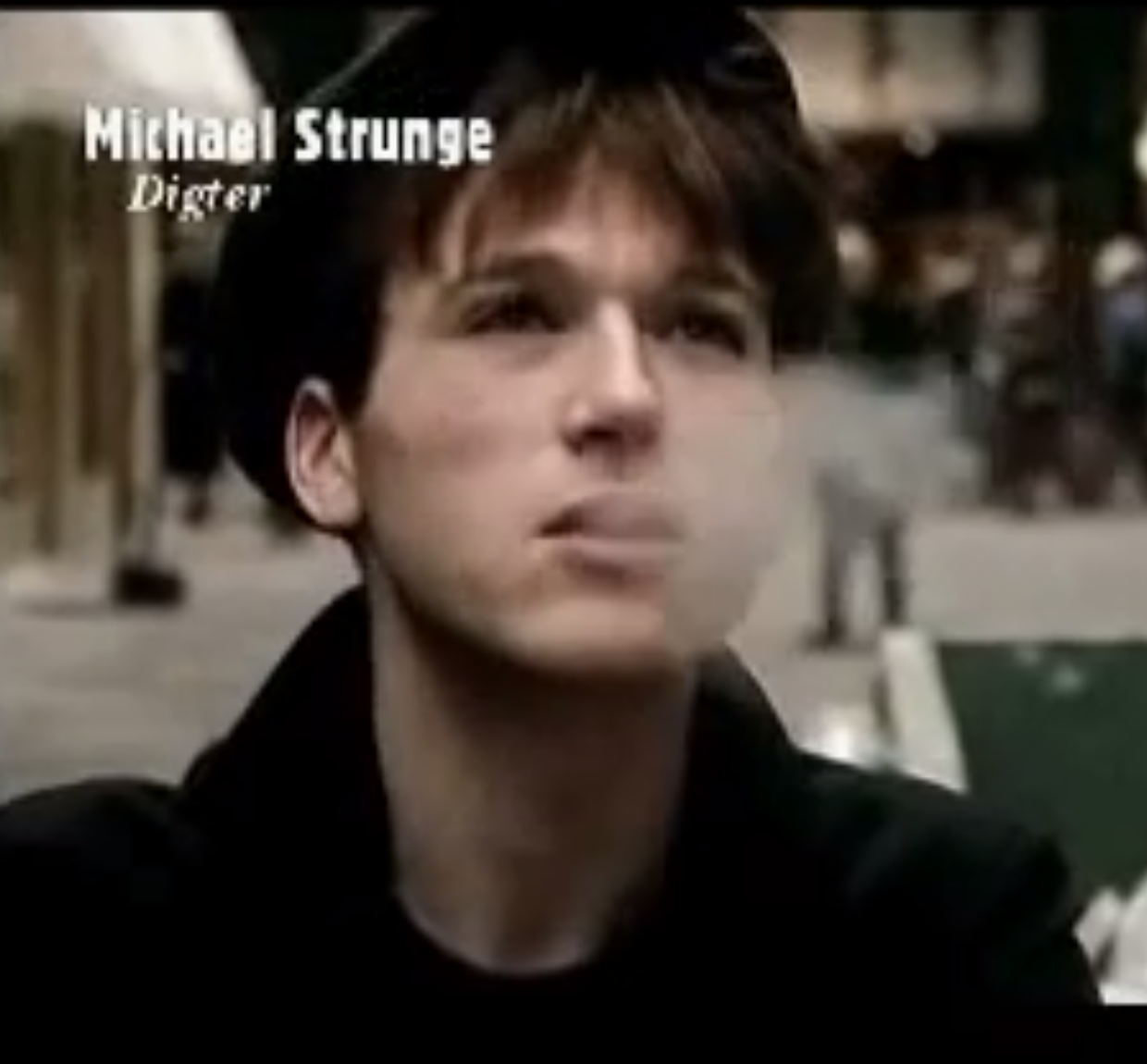
The final translation I'm presenting today is from the work of the quintessential New Wave post-punk poetic voice in Denmark, Michael Strunge, who died by suicide on March 9, 1986.


Posthumously, Strunge became the most popular poet in Denmark since Klaus Rifbjerg - and in contrast to the two first poets I've mentioned, Strunge was very much an urban voice in Danish poetry. Here is my new translation of his 1984 poem, "When we're asleep" from his collection Armed with Wings...


Note how in the poem the voice of the speaker originates from an apartment in the city and ends up encompassing all of the surrounding landscape. Strunge is far from the first poet to compare the hearts of lovers to a pair of birds - in fact Nis Petersen did exactly that in one of the poems in Nattens Pibere, where he wrote:

"Men tænk, om to mennesker vågnede midt
om natten og glemte, hvad mit var og dit
og sang — bare sang som hr. Kvirrevit
og fru Kvirrevit
kvirrevit!
vit!"

"Imagine two humans waking up one night,
Forgetting what was mine and what was yours
and sang — just sang like Mr. Chip-Chirip
and Mrs. Chip-Chirip:
Chip-chirip!
Chip!"

I'm not suggesting a direct intertextuality between the two misfit poets here, but for sure a commonality of theme and imagery.

As far as I can tell none of these Danish poets from three different generations have been translated into English before. I hope some will enjoy their work.

Monday, June 15, 2009

Translating poetry

During the long hiatus this blog has had I have mainly worked with a different type of blogging on a Tumblr platform. Under the title Ordinary Finds (originally intended as a companion to this blog's self-professed 'rarer finds') I have produced close to 5.000 posts - most of them visual rather than text-driven - mentioning important cultural figures from the fields of literature, art, film, music etc.

However, I have frequently experienced language problems when trying to disseminate knowledge about poets who didn't write in English and therefore have had their reputation in Anglophone countries largely depend on the quality of the translations of their work. Routinely I've come across language hampered by old-fashioned formulations, stiff meters, or melodramatic metaphors when looking for good versions of German Romantics or French Modernists alike. As a result I started producing my own translations for posting on Ordinary Finds and its more recent off-shoot Lumpy Pudding - whenever I felt that I was able to improve on the already existing work, or in extreme cases when nothing at all was at hand in English...
I thought that now I would take the opportunity to collect the work of this kind I've done more or less casually over the last 6 to 8 months. Here are seven of my translations from German, French and Romanian. The poets in question are Friedrich Hölderlin, Rainer Maria Rilke, Wolfgang Borchert, Lucian Blaga, Boris Vian and Hector de Saint-Denys Garneau...

~~~~~~~~~~~~~~

Recently my translation of one of Hölderlin’s best short poems, Hälfte des Lebens, was reprinted in the Stanford University program for their fifth Pan-Asian Music Festival - the occasion being the performance of Joji Yuasa’s setting of the poem for chorus and orchestra, entitled Cosmic Solitude… This event illustrates the importance of Hölderlin still: Japanese music, German Romantic poetry translated into English by a Dane, performed by a bunch of ‘Californians’ - good, no?

Hölderlin: One Half of Life

Hung with golden pears
and full of wild roses
is the land in the sea.
Your stately swans,
drunk with kisses,
dunk their heads
in the holy, sobering water.

Alas, where shall I take, when
winter comes, flowers,
sunshine,
and shades of the Earth?
The walls stand,
speechless and cold, in the wind
the banners rattle
.

.
Image - Markus Lüpertz: Ritter Hölderlin und Heine im Schwertkampf - Oil on canvas (The UBS Art Collection)

~~~~~~

Next, I felt the need to tackle Rilke's Herbsttag, which has been translated numerous times by high-level American poets - with quite miserable results. A web page conveniently gathers all the bad ones here...
.

.
Here's my take:

Harvest Day

Lord: it is time. The summer has been huge.
Lay your shadows across the sun dials,
in the fields let the winds run loose.

Command the last fruit to ripen;
give it two more Southern days,
force it to completion and chase
its last sweetness into the heavy wine

He who still has no house shall never build.
He who is alone shall be given short shrift,
shall read and write long letters, shift
and restlessly pace the lanes that skirt the field
watching as the leaves drift.

~~~~~~

I knew little about Wolfgang Borchert before encountering his birthday, but after a little reading I began to admire his political stance as well as his writings. I chose one of his simple poems to translate, but on Ordinary Finds I also posted a mini-bio and an excerpt from his anti-war manifesto, Then There Is Only One Thing To Do...
.

.
Wolfgang Borchert: Try to
Stand in the middle of the rain,
Believe in the blessing of the drops,
Cover yourself in its noise
And try to be good!

Stand in the middle of the wind,
Believe in it and be a child -
Let the storm enter you
And try to be good!

Stand in the middle of the fire -
Love this monster
With the red wine of your heart
And try to be good!

~~~~~~~

Shifting to Romanian poetry, which of course I have been introduced to chiefly by my wife Camelia (who many years ago gave me a trilingual edition of Blaga - which did not have English versions in it!), I quickly ran into problems whenever I wanted to research well-known Romantic or Modernist poets, since they were hardly ever translated into English - or if they were the translations were horrible...

Lucian Blaga was a particular favourite of mine, so I had to do two poems of his, one for OF and one for Lumpy:
.


Quietude

It is so silent all around me that I can hear
the moonbeams when they strike the windows.

Inside me
a stranger’s voice has come awake
singing of a longing that is not mine.

They say that those who died before their time long ago
with young blood in their veins,
with strong passion in their blood,
with strong sunlight in their passion,
will come,
come and live on
in us
those unlived lives.

It is so silent all around me that I can hear
the moonbeams when they strike the windows.

Ah, who knows in whose breast – once, in eternity
you, my soul, will play
on the soft strings of silence,
on the harp of darkness –
a choked-off song of longing and desire to live? Who knows, who knows?
~~~

The Light

The light I feel
streaming in my breast when I see you,
is that not a drop of the light
created on the first day,
that light which thirsts for life?

Nothingness lay dying,
as the impenetrable one, hovering alone in the dark,
gave a sign:
Let there be light!

An ocean
and a raging storm of light
arose in an instant:
a thirst for sins, desires, longings, passions
a thirst for light and sun.

But where did it go, that blinding
first light – who knows?
The light I feel
streaming in my breast when I see you – wondrous one,
may be the last drop
of the light made on that first day.

~~~~~~

While Camelia could certainly help me with the Romanian language (and I am grateful that she did), since it is her mother tongue - and while I have a pretty good command of German myself, the thought of translating from French (a language I have a somewhat troubled relation with) seemed utter lunacy... Still, it wasn't hard to see that a lot of the poetry I was interested in posting could use a bit of a face-lift, and I often managed with the help of pre-existing versions to streamline the texts I enjoyed...

Boris Vian was always a particular favourite:
.

.
I don’t want to croak
Without having known
The black dogs of Mexico
Who sleep without dreams
The monkeys with bare bums
Devourers of the tropics
The silver spiders
With nests stuffed with bubbles
I don’t want to croak
Without knowing if the moon
Under her false nickel-face
Has a pointed side
If the sun is cold
If the four seasons
Are really only four
Without having tried
Wearing a dress
On the grand boulevards
Without having looked
Into a sewer inspection-hole
Without having put my prick
Into some bizarre corners
I don’t want to end
Without knowing leprosy
Or the seven maladies
One catches down there
The good or the bad
None of them bother me
If if if I knew
That I would have the first of it

And there is also
All that I know
All that I value
That I know pleases me
The green depth of the sea
Where the strands of algae waltz
On the rippled sand
The baked grass of June
The crackling earth
The scent of the pines
And her kisses
Now here, now there
Her beauty obvious to all
My Bear cub, Ursula
I don’t want to croak
Before having used
Her mouth with my mouth
Her body with my hands
The rest with my eyes
I say no more, it’s better
To stay reverential

I don’t want to die
Before someone has invented
Eternal roses
The two hour work-day
The sea at the mountain-side
The mountain at the sea-side
The end of sadness
Newspapers in colour
All children happy
And so many gadgets still
Asleep within the skulls
Of genial engineers
Of jovial gardeners
Of civil citizens
Of urbane urbanites
And thoughtful thinkers
So many things to see
To see and to hear
So much time to spend
Searching in the dark

As for me I see the swarming
End arriving
With his lousy mug
Opening for me his
Bandy toad arms

I don’t want to croak
No Sir, no Ma’am
Before having explored
The flavour which torments me
The flavour which is the heaviest
I don’t want to croak
Before having tasted
The flavour of death.

~~~~
.
.
On the morning of June 23, 1959, Boris Vian was at the Cinema Marbeuf for the screening of the film version of his novel J’irai cracher sur vos tombes. He had already fought with the producers over their interpretation of his work and he publicly denounced the film stating that he wished to have his name removed from the credits. A few minutes after the film began, he reportedly blurted out: “These guys are supposed to be American? My ass!” He then collapsed into his seat and died from sudden cardiac death en route to the hospital.

~~~~~~~

Finally, my latest find, Hector Saint-Denys Garneau, the French-Canadian Modernist who died tragically young, and who seems to anticipate this fate in one of his poems:
.

.
Hector de Saint-Denys Garneau: Bird Cage

I am a bird cage
A cage of bone
With a bird

The bird in the cage of bone
Is death building his nest

When nothing is happening
One can hear him ruffle his wings

And when one has laughed a lot
If one suddenly stops
One can hear him cooing
Deep down
Like a small bell

It is a bird held captive
Death in my cage of bone

Wouldn’t he like to fly away
Are you holding him back
Am I
What is it

He cannot fly away
Until he has eaten all
My heart
The source of blood
With its life inside

He will have my soul in his beak

Wednesday, June 10, 2009

Forthcoming from Edge of Maine Editions


Monday, June 1, 2009

Navigating One’s Way through the Labyrinth by Robert Gibbons


The pleasure of the labyrinth depends on one’s ability to risk everything to make it through, trust one’s instincts, find joy on the wall of the cul-de-sac during the interim as much as that of the secret rune uncovered in the structure’s center, haft of the double-ax. Keeping a journal, diary, log, notebook is much like navigating one’s way through the labyrinth, turning the new blank page as if turning a corner. I get word today from Bent that Pepys finally abandoned his journal on this day, May 31, 340 years ago, basing his reason on loss of sight. He records a final revel with friends at a pub called The World’s End, & rightly compares closing the diary for good with descending into the final underground chamber of the grave itself.

Monday, April 21, 2008

The Big L

Yesterday was my birthday and my wife treated me to two presents in three phases. First she gave me poetry and then a surprise party. Those were the presents - the phases, while related to the presents, are more complicated: The first phase stretched from February 1996 to the present day and promises to continue. The second phase can be pinpointed to have started at almost exactly 3.30 yesterday afternoon, and it could well be over by now (at least the guests have gone home). Anyway, there is no sign that the third phase has started yet, so it may well be entirely mythological...

The poetry was very good yesterday, as it materialised for the first time in the form of a publication that wasn't labelled criticism or theory, but actually 'poetry'. Camelia has always wanted to be a published poet, and I've referred to her as one ever since her first 'academic' piece appeared in 1999. As I recall, that piece referred to Wittgenstein, as does the most recent manifestation of her poetical prowess, Eight Senses Plus One... As I further recall, none of the many interceding works, nor the first and the latest contain the word 'poshes'. This, the critics find surprising and a potential shortcoming, but that is about the only one they've spotted so far. Bah-bah! they say happily and insistently (critics are usually sheep, but rarely as literally as in this case...)

Yesterday, I didn't do a thank you speech, but here it is: Thank you all for contributing, being a captive audience and moving along your merry way with a nice chapbook in hand, bag or pocket!

I'm going to quote one of the poems, not the shortest nor maybe even the best, but the one that riffs on the L word. From Unison:

It occurs to me that cloning sounds a bit like loony baloney. My husband says, quoting John Lennon: "all you need is love." "It's a good beginning," I say. "The letter L has just cloned itself." Accompanied by Bach it turns itself into a (singing) number. More. Or less.
I figure George Clooney is loony-ballooning in there somewhere, but I'll settle for being a fifty-something like most of the great leading men seem to be these days. Fifty, fit and fighting, I embrace the One Big L.

Friday, April 18, 2008

Nirvana No

Sparked off by some of my recent posts on spirituality and quests for insight in relation to the work of Van Morrison and of the Beats, I have started thinking about some of the conundrums Western artists find themselves in when they become fascinated with Eastern belief systems.

Both Jack Kerouac and Van Morrison have frequently referenced Buddhism in their works (novels, poems, songs) In fact, Kerouac read widely in Buddhist texts over a period of several years, and eventually started composing his own sutras, or contemporary versions of sacred texts. Morrison has, of course, dropped references to both Kerouac's novels and to well-known Western popularizers of Buddhism in several of his songs... One key figure in this gamut is Alan Watts, who was English but lived the better part of his active life as a Buddhist popularizer in the USA (he died in 1973). The author of more than 25 books and avid lecturer and broadcaster, Watts' ideas are still being disseminated in today's media, via posthumous book publications, on discs, DVDs and on the Web... At some point Kerouac met and became friends with Watts, and he appears as a character in two of Kerouac's novel, Desolation Angels (as Alex Aums) and Big Sur (as Arthur Wayne). Morrison primarily glosses Watts' work in a song aptly named "Alan Watts Blues" (on Poetic Champions Compose) where the chorus is a rendition of the title of a Watts book: Cloud-hidden Whereabouts Unknown. The bridge lyrics go like this:

Sittin' up on the mountain-top in my solitude
Where the morning fog comes rollin' in
Just might do me some good.

Such sentiments echo very well with a Beat writer such as Gary Snyder, whose translations of Han Shan's Cold Mountain poems, for instance, sound very similar:

I settled at Cold Mountain long ago,
Already it seems like years and years.
Freely drifting, I prowl the woods and streams
And linger watching things themselves.
Men don't get this far into the mountains,
White clouds gather and billow.
Thin grass does for a mattress,
The blue sky makes a good quilt.
Happy with a stone under head
Let heaven and earth go about their changes.

Clambering up the Cold Mountain path,
The Cold Mountain trail goes on and on:
The long gorge choked with scree and boulders,
The wide creek, the mist blurred grass.
The moss is slippery, though there's been no rain
The pine sings, but there's no wind.
Who can leap the word's ties
And sit with me among the white clouds?

As a result of Watts' acquaintance with the Beats (he first knew Snyder, who was a serious Zen acolyte and also known to D.T. Suzuki, the first scholar to disseminate a knowledge of Buddhism in English) he wrote a fairly well-known essay titled "Beat Zen, Square Zen, and Zen", originally published as a pamphlet by City Lights Books in 1959, then collected and re-published in the Random House essay collection This Is It in 1962. Here are his definitions of the different mind sets to approaching Zen:

Square Zen is a quest for the right spiritual experience, for a satori which will receive the stamp (inka) of approval and established authority. There will even be certificates to hang on the wall. [Whereas f]or beat Zen there must be no effort, no discipline, no artificial striving to attain satori or to be anything but what one is. [He describes its self-defensive underside] But for square Zen there can be no true satori without years of meditation-practice under the stern supervision of a qualified master.

Not only did Watts identify the typical Western approaches to Zen as Beat or Square, respectively - pinpointing these approaches' short-comings (one is not serious enough and seeks instant gratification, the other is more philosophical than spiritual and caters to the intellect rather than the soul...), but in The Joyous Cosmology (1957) he had already offered a more history of ideas founded account of the difficulties of reception of Eastern religion for a Western mind-set:

The practical difficulty is that Taoism and Zen are so involved with the forms of Far Eastern culture that it is a major problem to adapt them to Western needs. For example, Eastern teachers work on the esoteric and aristocratic principle that the student must learn the hard way and find out almost everything for himself. Aside from occasional hints, the teacher merely accepts or rejects the student's attainments. But Western teachers work on the exoteric and democratic principle that everything possible must be done to inform and assist the student so as to make his mastery of the subject as easy as possible. Does the latter approach, as purists insist, merely vulgarize the discipline? The answer is that it depends upon the type of discipline. If everyone learns enough mathematics to master quadratic equations, the attainment will seem small in comparison with the much rarer comprehension of the theory of numbers. But the transformation of consciousness undertaken in Taoism and Zen is more like the correction of faulty perception or the curing of a disease. It is not an acquisitive process of learning more and more facts or greater and greater skills, but rather an unlearning of wrong habits and opinions. As Lao-tzu said, "The scholar gains every day, but the Taoist loses every day."

The practice of Taoism or Zen in the Far East is therefore an undertaking in which the Westerner will find himself confronted with many barriers erected quite deliberately to discourage idle curiosity or to nullify wrong views by inciting the student to proceed systematically and consistently upon false assumptions to the reductio ad absurdum. My own main interest in the study of comparative mysticism has been to cut through these tangles and to identify the essential psychological processes underlying those alterations of perception which enable us to see ourselves and the world in their basic unity. I have perhaps had some small measure of success in trying, Western fashion, to make this type of experience more accessible.

To illustrate this difficulty I propose to briefly return to the work of first Kerouac, and then Morrison. A poem sequence such as the spontaneously composed Mexico City Blues by Kerouac illustrates the limitations. In this book Kerouac on several occasions riffs on key notions in Buddhist faith, such as Maya (the notion that all, including human suffering, is an illusion - a veil, hiding the true nature of things - namely that no thing exists). He also plays with the idea of Nirvana, a state of grace where the believer has understood that nothing is real, and that Nirvana is the cessation of existence in the world of illusion. In a previous paper I made reference to how a specific sequence of poems approaches Nirvana:

The most discussed and anthologised thematic chorus sequence in Mexico City Blues is the one eulogising Charlie Parker, which rolls from poem 239 through 242 of the collection, and thus forms the coda to the whole book. There are, however, numerous other such chains of choruses with identifiable thematic connections creating coherence across individual pages. A good example of such a chain are choruses 196 through 201, which arise out of a longer, more vaguely interconnected thematic meditation on Buddhist tenets to riff specifically on the notion of Nirvana, and the application of Nirvana as a shade of lipstick, called “Nirvana No”, to barroom girls disturbing or tempting the Buddhist sage in his meditations. Most of the Blues poems are self-contained units, ending as a page gets filled up with text. Poems can however run on, onto the next sheet(s) as illustrated by the identification of chains of choruses discussed above. On the other hand there are many examples of apparently prepared run-on lines ending one chorus, but not being picked up in the next. One good example is the last line in the Nirvana sequence which reads “And they claim”, but we never learn what it is they claim, as the next chorus seems a self-contained meta-poem starting: “A white poem, a white pure/spotless poem” (202). On the whole Mexico City Blues can be said to thematise the quest for purity of mind and belief in a world full of temptations of the flesh, a world where the speaking and writing subject suffers but seeks help and illumination from selected culture heroes, (Buddhist sages as well as Charlie Parker) and as such the collection takes its place naturally among Kerouac’s other confessional works.

One could of course argue that writing the ''white poem" is a means of getting to Nirvana, and that would be a Zen stance. However, the follow-up notion that such a poem has to be "spotless" contradicts the move towards Nirvana, by the poet's getting hung up on achieving perfection within Maya. I think the operation in Kerouac's mind is typical of the Western way of thinking within the box of attainment, quality, perfection. Nirvana is not perfection, but the cessation of the striving for perfection.

Van Morrison's tribute to Watts seems to imagine the trip to the mountain top as a small stay at the spa, a detox of the mind, after which the poet returns to the grind of everyday life and its temptations:

I'm waiting in the clearing with my motor on
it's time to get back to the town again
Where the air is sweet and fresh in the countryside
Well, it won't be long before I get back here again.

This again is similar to the way Kerouac ends his Desolation novels, Dharma Bums and Desolation Angels. The poet returns purified, but with the knowledge that this state will not last. In Kerouac's case the root to the flaw is already laid during the meditations on the mountain top where he has realized that all is illusion, but fails to take the final step of realizing that the suffering caused by this realization is also illusion. In Morrison's case one almost gets the feeling that the cleansing procedure is an established routine, not a one off extraordinary event that might lead to satori...

I end with a video of Watts' Conversation with Myself. There are 2 more parts easily available on YouTube...


Tuesday, April 8, 2008

That's Entrainment

For years I listened to at least one Van Morrison track every day, often playing one of his songs to energize myself before going in to teach a class or give a lecture. We're talking major obsession, here... so bear with me and this long post.

These days my Van-time comes in waves, on and off. Lately it's been on to an unusual extent, due not only to the release of his latest album Keep It Simple, but also to a belated discovery of his 2002 disc Down the Road which I had not paid particular attention to when it was released (being in a Van slump a the time), but which I now realize contains some really good material. To add to this rather muddled frenzy I have also recently acquired the 3CD version of Still on Top, the better of the several greatest hits packages available on a crammed Van-release market... The advantage of such an eclectic bunch of Van sounds is that one gets hip to connections one might not otherwise have noticed between periods, themes, melodic strands and influences in Morrison's output.

I had in fact written briefly about portions of Down the Road in a piece I published a couple of years ago on the theme of exile and homecoming in Van's songs. Down the Road contains a song that I think is pretty unique in Van's output as far as lyrics go. "Choppin' Wood" (which musically is not very interesting) tells the story of Van's father as an Irish emigrant to the US who eventually came home to Ireland disillusioned and lived out his days in Belfast ("a life of quiet desperation", as Van puts it borrowing a phrase from Thoreau), working the shipyards to feed his family ('choppin' wood' is Van's Walden-inspired metaphor for that grind and routine) yet never giving up his inner life and fascination with America. Van's many heroes have always been literary greats and musical mentors, but this one time we hear about his personal history and the person who moulded him the most. Van often talks about his father in interviews, but usually just about his record collection and interest in blues and jazz music. Recently, though, Van told an interviewer (Barry McIlheney, in the Members only portion of Van's official web-site) a more personal anecdote:

My father used to get this magazine called Jazz Journal and I read a review of a Ray Charles record in that. And my dad used to tune in to AFN, the American Forces Network in Germany, and one night lying in bed after midnight I was listening to AFN and I heard "What’d I Say", and I just knew it was Ray Charles. And I shouted down the stairs, “Is that Ray Charles?”, and my dad shouted back, “Yeah, it’s Ray Charles”. I don’t know how I knew as I’d never actually heard anything by him ever before that night, but somehow I just knew it was him.
I really enjoy how Van's father gets to OK that Van gets a new, musical 'father' in Ray Charles by just 'knowing' him over the airwaves...

My little academic piece on Van was mainly about how a stream of references to exile and homecoming and all the questing that lies between runs through Van songs covering 5 decades and also shades and shapes his album covers, the names he gives to his production companies, touring bands, and every aspect of his public appearance. The latest albums have done nothing to change that impression - quite the contrary, I see Van's post-millennium work as largely a revisiting and reworking/refining of the same themes. Here is a quote from my article, "The Celtic Ray - Representations of Diaspora Identities in Van Morrison Lyrics":
In numerous songs spread out over his whole recording career, Morrison references his origins, childhood and youth in Belfast, where he was born in 1945. He grew up on Hyndford Street in a lower middle class neighbourhood in Protestant dominated East Belfast. However, his parents were not typical Ulster Protestants: Morrison’s father, George, came from a family with Scottish, Presbyterian roots, and was an electrician by trade, but really more interested in his passionate hobby of collecting American blues, bluegrass, country and jazz records. Morrison’s mother, Violet, unexpectedly developed an intensely religious zeal at the time when Morrison was around 10, but contrary to the norm she channelled her beliefs into Jehovah’s Witnesses activities (hence Morrison’s tribute “Kingdom Hall” on his 1978 album Wavelength). This combination of a worldly father, whom Morrison has repeatedly described as an atheist, and a spiritual mother, would immediately seem to have set Morrison on his subsequent path of vacillation between belief and doubt. The parents seem to have embodied the same polarity of personality facets that Morrison himself exhibits: The father an introverted uncommunicative non-believer, ultimately disappointed with his life in Belfast; the mother an extrovert, performative personality, eager to communicate her views to people even to the extent of trying to convert them religiously.
Other than the rare glimpse of family history found in "Choppin' Wood", Down the Road also contains such nostalgic songs as "The Beauty of Days Gone By", which on later albums such as Magic Time and Keep It Simple has found companion pieces in "Celtic New Year" and "Song of Home," respectively. The title track from Down the Road and the closing track on that album, "Fast Train," are songs of leaving home but never escaping completely, and on Keep It Simple they are echoed in the song "End of the Land". So, the weaving of this strand of longing for belonging is clear even in Van's latest songs, as indeed they have been since the 60s (but you'd have to read my article to get that analysis. You can find it in the book Re-Mapping Exile, available here as an E-book)...

The other strand that runs pretty consistently through Van's songs is his fascination with the spiritual and his ceaseless quest for finding ways of touching the sublime and ineffable. This quest had led him along some strange by-ways, including Scientology and the bizarre esoteric work of Alice Bailey and the reincarnated "Tibetan" sage she channels in her work. Van has also been into Celtic mysticism, gnostic Christianity, Buddhism and other Oriental brands of religion and spiritual techniques. It is perhaps not surprising that he continues to write about such matters, also on Keep It Simple... After all, many such belief systems are exactly attempts at simplifying and clarifying a person's life on Earth (sometimes in preparation for a better afterlife or return, depending on what one expects in terms of karmic rewards).

I said a bit about this in my article too, so you get one more quote for free:
Morrison’s notions of Celtic brotherhood can be seen as a hybrid between American New Age philosophies and Irish identity positions (both identity constructs oscillate between collectivist messages and individualist realisations of them). Morrison’s quest for enlightenment became more and more explicit throughout the eighties as witnessed by album titles such as Beautiful Vision from 1982 and Inarticulate Speech of the Heart from 1983, as well as Sense of Wonder (1985), Avalon Sunset(1989), and finally Enlightenment (1990). Only on a surface level did an intervening album title from 1986, No Guru, No Method, No Teacher, appear to contradict the singer-songwriter’s quest for esoteric knowledge, since that album title is in fact a quote from Krishnamurti, the mystic messiah trained by the Theosophical Society (founded by Madame Blavatsky) to enlighten the world. Morrison songs from the 1980s are glosses of teachings from a number of esoteric, New Age or occult beliefs, including Scientology, whose founder L. Ron Hubbard, is explicitly thanked in the liner notes to Inarticulate Speech of the Heart. The richest vein mined by Morrison in those years is, however, the writings of Alice A. Bailey, whose theories concerning illusion, glamour, maya, and the strange entity known as “The Dweller on the Threshold” – all obstacles to true enlightenment – can be traced on several Morrison albums.

The postulate here is that this hybrid of esoteric knowledge, Irish identity longings, and a cross-cultural musical style and performance, creates the only viable recipe for life for Morrison whose character reflects a contradiction between an extremely shy and private persona, and an extroverted performer persona whose only existence is in the public gaze. Morrison is thus seen to be “Hiding in the Light”, to gloss Dick Hebdige’s 1980 book of the same title, which details the narcissistic paradox of hiding and exposure inherent in subcultural deviance, which seems apt to characterise Morrison’s desires as well. This duality is further mirrored in Morrison’s own internal and external exile positions, and partly explains his continuing quest for identity, figured as a battle between revelation in the form of enlightenment and concealment in clouds of mysticism.
People have not yet made the connection between Eastern mysticism and the lyrics on Keep It Simple, but I'll gladly be the first one to point them out. Most reviewers have commented on the track "That's Entrainment" (which is one of the really sublime songs on the new disc, captivating you with its simple chords, repetitive chorus, Van's vocal riffing and the accompaniment effortlessly laid down in what sounds like a first take) - often wondering what the strange word 'entrainment' might mean. Some reviews offer dictionary definitions (Physics: 'the process whereby two interacting oscillating systems assume the same period'); others like the one in Rolling Stone gloss it as being in a 'trancelike realm'... Dave Heaton in PopMatters makes a full paragraph out of a valiant effort to describe the song and understand the title:
Partly because of the singing, “That’s Entrainment” immediately stands out, one to add to the lengthy list of classic Van Morrison songs. The third track, it’s the first riveting moment of the album, possibly the first from Morrison in a while, where he holds time still like he used to. He starts singing right at the song’s opening seconds, painting a picture of a countryside, then of himself standing in rapt fascination, struck by the pure beauty of an unspecified “you”, seemingly the spiritual force of nature, but sung to like a lover. Handclaps and other hand percussion provide the song’s backbone, as Morrison sings up and down the hills of that countryside, eventually expressing his awe in the terms of classic R&B—when “you” come around, it makes him holler, makes him want everyone to shake their collective moneymaker, shake it on down. At first the chorus of “That’s entrainment” is jarring amidst all this ecstasy and calm, if only because it begs the question, “What the hell is entrainment?” As far as I can tell, it’s all about being drawn in and transformed, the way air forms into a cloud.
Well and good, all - but no cigar, as Freud said to his mother. Entrainment is indeed both "the synchronization of organisms to an external rhythm" and the practice of "the practice of tuning one's brainwaves to a desired frequency", but while I wouldn't put it past Van to have read books about biomusicology and neuroscience, I find it a million times more likely that he once again dipped into his extensive library of Eastern religious esoterica and New Age philosophy. Let's do the same: 'Entrainment', in the esoteric sense of the word, is a concept directly related to music and poetry and the performance thereof. Read this (lengthy, sorry!) excerpt from a home page on Indian music and its function in worship and meditation:

The musical forms, kirtan and bhajan, are essential components of virtually all Hindu worship, as well as of related traditions, such as Sikhism, where they play an indispensable role. More similar than different, both are related to jaapa, or repetition of the Sacred Name, and group participation is usually emphasized. An interesting distinction is that while bhajans are commonly performed as such for listening audiences, kirtan - usually a group devotional practice - requires participation, rather than taking the form of a performance. Kirtan typically employs fewer and much repeated phrases, while a bhajan may contain elaborate verses and melodic improvisations, sometimes with sung mono-syllables (generally, the names of the notes, themselves). Both employ melodic structures based on the Indian classical raaga form, where the emphasis is on rhythm and melody, rather than harmony. And, while kirtans generally take only the names and qualities (guna) of the Divine, bhajans often employ ornately poetical lyrics from the greatest of Indian poets, including Rabindranath Tagore, Tulsidas, the Sufi Kabir, and the great woman saint, Meerabai.

A delightful aspect of kirtan participation is the opportunity for entrainment. Entrainment happens when one object or person comes into rhythmic synchrony with another. Experiments have demonstrated that two clocks placed side by side may begin to tick together after some period of time. Similarly, the strings of one lute may resonate sympathetically in relation to a nearby lute, identically tuned. According to this principle, the members of a kirtan sangha may come into synch with one another during the process of chanting melodically and rhythmically. Further, as the root forms of kirtan typically derive from classical raagas, the melodies may help to synchronize us with Nature or the Cosmos, itself. Also, when we sing or chant, the breath necessarily becomes rhythmic, and this may encourage balance and equanimity. This factor, along with the sounds or meanings of the sacred and ancient words, may have multifarious beneficial effects on the mind, body, and spirit. Also, it is said that one need not even participate in kirtan to derive its many benefits; merely listening attentively to the devotional music may uplift, inspire, and even heal the listener at some level. Stress, negativity, and "self-grasping" may all be let go during participation or listening to kirtan.
"...merely listening attentively to the devotional music may uplift, inspire, and even heal the listener at some level." Did ye get healed? - as Van asked us back in '87 on Poetic Champions Compose (thanks for the correction, Eoin), one of many albums drawing heavily on a mix of literary influences (Yeats) and religious inspiration (Alan Watts' notions of Zen). The above quote gives us the necessary understanding of Van's idea of entrainment: phrases such as 'repetition of the Sacred Name', 'elaborate verses and melodic improvisations, sometimes with sung mono-syllables' are often applied almost verbatim to describe Van's performances. Van also frequently borrows ornate lyrics from great poets, and I am positive that he is familiar with Rabindranath Tagore, the anglophone Indian Nobel Laureate (1913 - the period Van often evokes through Yeats, T.S. Eliot and other modernist poets). So, Van's entrainment is his kirtan (what we get when we sing along) and bhajan (what Van attains when he goes into the zone of private performance)...

Not yet convinced? OK, did you read carefully enough to catch the reference to 'the Sufi, Kabir'? Kabir could easily be one of several inspirations behind Van's "No Guru, No Method, No Teacher", as the paradoxes of some of his poems reveal:
O SERVANT, where dost thou seek Me? Lo! I am beside thee.
I am neither in temple nor in mosque: I am neither in Kaaba nor in Kailash:
Neither am I in rites and ceremonies, nor in Yoga and renunciation.
If thou art a true seeker, thou shalt at once see Me:
thou shalt meet Me in a moment of time.

Kabir says, "O Sadhu! God is the breath of all breath."

Are you looking for me? I am in the next seat.
My shoulder is against yours.
You will not find me in the stupas, not in Indian shrine
rooms, nor in synagogues, nor in cathedrals:
not in masses, nor kirtans, not in legs winding
around your own neck, nor in eating nothing but vegetables.
When you really look for me, you will see me instantly —
you will find me in the tiniest house of time.
Kabir says: Student, tell me, what is God? He is the breath inside the breath.
Seeking, meeting, breathing - all vintage Van obsessions... And who translated Kabir's poetry into English? Rabindranath Tagore, of course...

The reference to Sufism on Keep It Simple comes in the most bhajan-like song on the album, the 7 minute long closer, "Behind the Ritual" ('Behind the ritual, you find the spiritual'). Van wails about days in the alley (a familiar locality from many Van songs, usually associated with 'jelly roll'), spent "drinking that wine, making time, and talking all out of my mind" (rituals involving drinking wine and speaking in tongues, anyone? How about the Eucharist and the descent of the Holy Ghost...?) At one point Van refers to himself "turning and spinning in the alley, like a Whirling Dervish in the alley" - and that is your reference to Sufi mysticism - the ritual that a specific Sufi sect devised to achieve entrainment, spinning around your own axis until you attain enlightenment and oneness with God:
In the symbolism of the Sema ritual, the semazen's camel's hair hat (sikke) represents the tombstone of the ego; his wide, white skirt represents the ego's shroud. By removing his black cloak, he is spiritually reborn to the truth. At the beginning of the Sema, by holding his arms crosswise, the semazen appears to represent the number one, thus testifying to God's unity. While whirling, his arms are open: his right arm is directed to the sky, ready to receive God's beneficence; his left hand, upon which his eyes are fastened, is turned toward the earth. The semazen conveys God's spiritual gift to those who are witnessing the Sema. Revolving from right to left around the heart, the semazen embraces all humanity with love. The human being has been created with love in order to love. Mevlâna Jalâluddîn Rumi says, "All loves are a bridge to Divine love. Yet, those who have not had a taste of it do not know!"
Van's pan-esoteric religion has often led him to "pray to the One", go "across the bridge to the other side" (sometimes it's just a stairway leading to Vanlose railway station, but it is all one bridge leading to enlightenment) and "dump" his ego "on the burning ground"... Sufism is just the latest facet this Irish Dervish (a Persian word for the 'ascetic mendicant' - a propos of "Don't Go to Nightclubs Anymore" - whose function is to be a "source of wisdom, medicine, poetry, enlightenment, and witticisms"). Examples of punny wit abound on Keep It Simple - here are two:

"That's Entrainment" puns on the old Musical (retrospective) film That's Entertainment! and not least its punny title song. ("The chase for the man with the face: That's entertainment!")

The mantra, "Behind the ritual, you find the spiritual" reveals and hides at the same time that the word 'spiritual' is a portmanteau of the two words that are key to understanding the album: 'spirit' and 'ritual'...

Keep It Simple is a delightful album that turns a trick or two on you: it ain't as simple as you might think. More to follow...


Sunday, April 6, 2008

Mock-pluck Sonnet

OK, this should have appeared on April 1, but since we are still Fools, I guess I can go on and post it. The 'work' originally came about as a comment to my wife's post on Philosophy and Aesthetics: Actant Art: the 'je-ne-sais quoi' as a 'notarikon'. As I have no doubt as to what I prefer, I cast the following 'sonnet' as the taunt of an aesthete to a philosopher:

Pluck the keen teeth from the fierce tiger's jaws,
Hold in perfection but a little moment.
If I could write the beauty of your eyes,
Let those who are in favour with their stars
Of public honour and proud titles boast.
Such civil war is in my love and hate.
O! Change thy thought, that I may change my mind,
Plod dully on, to bear that weight in me.
How would, I say, mine eyes be blessed made,
Yet do they steal sweet hours from love's delight.
But if the while I think on thee, dear friend,
Like to the lark at break of day arising,
All losses are restor'd and sorrows end -
Haply I think on thee, and then my state.
Note how the aesthete is preoccupied with beauty rather than honour and titles, and exhorts the philosopher to 'change thy thought'. The aesthete ends with a transcendent leap, 'like to lark at break of day arising', soaring above the heavy philosopher and disappearing in sheer heavenward bliss...

Of course, the 'sonnet' doesn't rhyme, and the sense it makes is quite fortuitous, for I coupled it together from lines from at least 10 different Shakespeare sonnets, plucking lines almost at random... Why? Read the first letter of each line as a vertical word, as one would in a primitive notariqon, and you will instantly see what I really think of philosophy!

All in good fun... of course. Camelia quite justly responded with a truly Shakespearean insult, calling me a paunchy plume-plucked puttock!

Friday, April 4, 2008

Upcoming conference plans: Little Magazines before and after the Web: The Case of Robert Gibbons

A month ago I posted about my plans to present a paper on the prose poetry of Robert Gibbons, seen as a form of life writing. Due to some shuffling of workshops and some wheeling and dealing behind the scenes I have instead been sold down the river to a workshop with a more overt cultural history and politics perspective, so that my paper now will have the title indicated in the heading for this post. That is fine by me - I intended all along to write a longer piece (and who knows, maybe a proper book) on Gibbons' fascinating practice and poetics - including a focused look at how his poetry is both political and personal.

On my university homepage I keep a log of my lectures and other speaking engagements. I now feature a page on ESSE-9 in Aarhus where I am going to first present my Gibbons-paper...

Here is the abstract:

The Survival of a Dissident Poet: Life in the Little Magazines before and after the Web – the Case of The Evergreen Review and Robert Gibbons

Robert Gibbons’ new volume of poetry Beyond Time – New and Selected Work 1977 - 2007 forms a rare vantage point from which to open a discussion of the themes proposed for this seminar on innovative voices on language and self. Over four decades Gibbons has remained an unincorporated, strongly political, and consistently dissident voice in the American landscape of little magazines and independent publication. Unaffiliated with any formal movement or coterie Gibbons has instead focused on developing his personal poetics of nonconformity, specializing in the hybrid form of the prose poem.

While being forced early on to depend on the acceptance of journal editors to find publication outlets, Gibbons has latterly begun utilizing internet and web-based publication options to a much larger extent. His spontaneous composition ideals make his output, which at times mimics forms such as the journal, the almanac and the blog, ideally suited for a quick turn-around in terms of publication. His confessions and reportage from a place-bound life on the streets of his favorite cities and among clean, well-lighted book-stacks balance carefully between the personal and the political, detailing the vagaries of having a compulsion to write for dear life while simultaneously being compelled to work for a living.

Parallel with his increasing utilization of ‘fast’ media, Gibbons has continued to work within more traditional little magazine outlets, such as The Evergreen Review, where recent poems have just appeared. The multiplication of publication outlets provided by the Web means that publication and gate-keeping in the arts have changed completely, and that whole new rules for peer, coterie and/or self-publication are now in place. Gibbons has navigated this new multifaceted field in a manner that could well be characterized as a celebration of 'indefatigable privateness', i.e. the visions of the individual – yet equally so as an indefatigable political commitment to a community, both local and global.
Some of my previous work on Gibbons can be found here:

Studio

The Atlantic Community

Gibbons' previous book, Body of Time, is reviewed here in The Evergreen Review

And here in Cercles by Camelia Elias in her inimitable fashion...

More info on Gibbons' work can be found here...

Here is how he presents his view on work, language and self at his relatively new web site:
Language having more to do with blood than dictionary, physical as much as cerebral. Spontaneous more than calculated. Rife with sensuousness. As internal as dream, eternal as memory. The insistence of pulse, breath, & bodily fluid. Blood of Love, I wrote once, dripping it repeatedly down the page, Blood of Love, Blood of Love, which could have culminated in a yell, “Stella!” If that were her name. Always the feet tracing streets from Paris to Barcelona; a dialogue of the citizenry of self with city & history. Skin & bone & wound. Letter by letter back home documenting experience. The second life of writing, as intense, or more so, than living. Aesthetic based on the tactile. The chew of the word. A certain taste, not always familiar. I’d film words like Godard, if I could, chant like Coltrane, if need be, paint a sign like Kline, however one has to get it down, send it out, make a note. Thrust & parry, the battle & pleasure.
Check out the rich vein of poetry flowing to his readers from his daily Log... A recent poem:
The Pleasure of the Text
Thursday, March 27,
2008

She arrived via the elevator of the dream announcing that my sources were in order, which meant the latest stack of books included the Goya amidst the foundation of black notebooks, Black Sun, again by Kristeva, the newly added Basic Writings of Nietzsche, & topped off by a little yellow paperback version of The Pleasure of the Text by Barthes, intimating that this latter held the greatest interest for her. Just the night before we’d already spoken of the transparency of the Soul, whenever it appeared in dreams, whether the rose enclosed in double panes of glass floating down the aisle of a public bus, or the vitrine that appeared after I told her I also loved the back side of her Soul. Now, for Barthes, the pleasure of the text culminates in the unveiling of the sex, but such an exposure that cannot come too quickly, & must be justified by the rhythm of the language leading up to its revelation, whether it be the rhythm of the dance, the musical counterpoint of Debussy humbly seeking to give pleasure, voyeuristic clothesline strung taut in a long novel, or the slow emergence of ideas from the body, which he says differ from those of his own.

Tuesday, March 4, 2008

The Beat Generation Revisited sequence

Over on the other blog I contribute to - The Atlantic Community - I have been posting online recaps and supplements to my current elective course The Beat Generation Revisited...

There are 6 instalments in the series proper, each based on a lecture, plus a few related items. Part 5 turned out longish, and therefore is divided in two parts. There is a total of 9 mini-lectures posted now that the teaching sequence is ended. The final instalment is based in part on mail-ins from my students with Beat related items they have found or were already familiar with...

Here are the relevant posts, if you want to get the low-down on the Beats:

0. Kerouac times

1. Basic Hip - Kerouac times, vol.2

2. Alan Ginsberg and the American Scream

2a. Howl tape unearthed

3. Dr. Benway, I presume...

4. Gary Snyder, Smokey the Bear, Avalokitesvara and other Bodhisattvas

5. "Minor Characters?" Beat Others, 1

5a. Beat Others, 2 - Racial Othering

6. The Beat Goes on...

Upcoming conference plans: Life Writing and R. Gibbons

I plan to attend several conferences this spring and summer. I am particularly excited about one upcoming event in August: ESSE-9 in Aarhus (just down the road from where I work). ESSE is the European Society for the Study of English and they meet every two years for a large conference with 50+ seminars and workshops. They also let in American Studies people, esp. if one can maintain a British accent for upward of 20 minutes...

I have proposed a paper for a seminar on Life Writing, a hot topic in literary studies right now:
The purpose of this seminar is to define and exemplify the increasingly popular genre 'life writing' in academic terms. In order to move beyond the stereotype of mass-market biographies we need critical discussion of different forms and definitions of life writing. We welcome papers seeking to identify and explain the contours and interfaces between producers, subjects and consumers of life writing; between memory and writing; between emotion and narration; fact, fiction and documentary styles; between personal and cultural history and between new textual technologies, e.g. on the Web, and the life of a text.
Here is my paper proposal:

The Survival of a Dissident Poet: Life Writing before and after the Web – the Case of Robert Gibbons

Robert Gibbons’ volume of poetry
Beyond Time – New and Selected Work 1977 - 2007 forms a rare vantage point for discussion of the themes proposed for this seminar on life writing. Over four decades Gibbons has remained an unincorporated, strongly political, and consistently dissident voice in the American landscape of little magazines and independent publication. Unaffiliated with any formal movement or coterie Gibbons has instead focused on developing his personal poetics of nonconformity, specializing in the hybrid form of the prose poem.

While being forced early on to depend on the acceptance of journal editors to find publication outlets, Gibbons has latterly begun utilizing Internet and web-based publication options to a much larger extent. His spontaneous composition ideals make his output, not least in the form of
a web log, ideally suited for a quick turn-around in terms of publication.

His confessions and reportage from a place-bound life on the streets of his favorite cities and among clean, well-lighted book-stacks balance carefully between the personal and the political, detailing the vagaries of having a compulsion to write for dear life while simultaneously being compelled to work for a living.

I aim to situate Gibbons’ dual practice of web as well as journal and book publications in the ever expanding spectrum of forms of mediated life writing.

I hope to do the multifaceted work Robert Gibbons is producing right now justice. His current daily log of poems is developing into a fine body of texts - hopefully ready to become a book in their second incarnation in a few months' time... A snippet from today's poem (with Robert's permission, I hope):

I don’t know where compassion stands among the grand list of Buddhist virtues, but the cold this morning placed me right there among the lowliest of the low, where poets belong. Spare change, madam, trickle down unemployment compensation, mister?

Right now I await acceptance of the paper proposal - hopefully within 3 weeks...

Monday, March 3, 2008

In America's Shoes: Andrei Codrescu

I am a fan of Romanian ex-pat author, Andrei Codrescu, who is now residing in the US - Louisiana to be more specific. Andrei is a great humorist, using his TRRENNSILLVAYNIAN accent to great effect, and generally taking a mock-naive approach to all things American - as witnessed by his frequent NPR commentaries.

There is also a nice PBS Frontline/WORLD resource page on Codrescu, as well as many YouTube videos featuring him:

Here he talks about the New Orleans literary scene and his journal Exquisite Corpse. There is also a dig against George W. Bush:


There is a very long video of the Charlie Rose Show in 1993 where Andrei and others talk about the Road and going on it - triggered by Codrescu's hilarious documentary Road Scholar in which he goes coast to coast in a cherry-red Cadillac convertible...


And to close - here is some laugh-and-cry poetry from Andrei's The Living Conditions of the Gods:


Codrescu is a fan of the Beat writers (as am I). A paper of mine on the influence of Beats such as Ginsberg and Kerouac on immigrant writers - including Codrescu - has recently appeared.

Codrescu gets the last word. On Romanians and their 'national traits':
Romanians are culturally European, very close to the French. Socially, they are now building a society that is emotionally closer to the Balkans, Turkey and Greece. The inept postcommunist governments have kept Romania from implementing quick reforms, so the economy is a mess, way behind Poland or Hungary. There was never a clean purge of the "formers," either in government or in the secret police. It's not so much a matter of traits, as a political problem.

Time has told me...

As this is the debut post on this informal blog/notepad, I should probably come clean about the title I have chosen for the blog. It is, as many will know, a quote from a song by late great songwriter, guitarist and singer, Nick Drake. More particularly it is a line from the song titled "Time has told me" which originally appeared on Drake's 1969 album, Five Leaves Left. I have a medium to severe Drake obsession, and have had since the mid-1980s - at which time Drake had long since been dead and buried. I won't go into the sad and poignant story of Drake's demise on this occasion, but will return to it at some later point...

Drake's memory is well-served by many tribute sites on-line:

nickdrake.net is a fan site which has bio, discography, lyrics (not completely accurate), and a media section w. links. A lovely feature is images of hand-written lyric sheets in Nick's own handwriting

NickDrake.com - the US fan site - has similar features, plus fan fora for discussion and sharing of Drake-lore. There are regular news updates on the entry page.

NickDrake.co.uk is a lovingly crafted English fan site with nice Flash animations. One of its unique features is a collection of fan artwork. A good feature here are sound files of Nick speaking There is an mp3 (w. transcript) of an old tape on which Nick Drake can be heard rambling about life and his tenuous place in it.

Bryter Music - The Estate of Nick Drake is the official site administering Drake's legacy. It is a friendly site, streaming many of Drakes song as one browses the pages. The aesthetics of the site are second to none, and some resources are unique to this site. I recommend reading Gabrielle Drake's moving posthumous letter to her brother...

A Place to Be is a collection and celebration of the impact of Drake's music on other artists. Here more content will appear as the collection evolves and moves from curator to curator. It was as part of this project that the much discussed video, featuring "Black Eyed Dog", which Heath Ledger directed and starred in shortly before his death, was first shown.

There is even a decent MySpace site for Nick Drake with 4 songs...

The Nick Drake Files is a now stagnant fan site located in Sweden.

As for book length bios, there are now several available, but all are speculative and occasionally strangely sensationalist... I was particularly troubled by the Trevor Dann book, which suggests - based on slim evidence from Drake's lyrics and poorly executed textual analysis - that Nick Drake was a traumatised or even abused child. We are waiting for the appearance of the first truly congenial Drake-bio - hopefully in 2009...

Two Drake DVDs will help tide us over: A Skin Too Few (available with purchase of the box set of Nick Drake's recordings, Fruit Tree) and Under Review - but separate reviews of those films will be posted here at a later point in time...