Showing posts with label Translation. Show all posts

Thursday, March 14, 2019

Leslie-Ann Beldamme: "The One I Love"

I have just re-purposed my Tumblr blog with a focus on Danish writers and artists, and started translating little pieces of prose and poetry for that. This work pleases me a good deal, and who knows what collections it might lead to...

The work involves finding cool Danish, or - in a pinch - Scandinavian birthdays, and every now and then I stumble over a name that is vaguely familiar, but which I can't quite place. This happened yesterday when I was researching the March 15 birthdays. "Anna Castberg? Who was she, again?"

Well, as it turns out, Anna Castberg is mainly remembered in Denmark for a moment of infamy when she was caught lying on her resumé for the job as Museum Director at the recently built Arken museum - a lovely edifice on the coast just outside Copenhagen, which specializes in Contemporary art.

Ms Castberg was pre-eminently qualified for the job as Director with her PhD in Art History and extensive museum experience, and she was hired in 1993 to build up the collection and launch the new museum in 1996.

Soon, however, the Danish newspapers took a keen interest in the budgets for the new museum which seemed rather out of control, and a bit of digging soon revealed that Castberg didn't really have a degree of any sorts and didn't actually attend any of the universities she claimed to have gone to. She also hadn't really worked for the institutions she had listed on her resumé as prior experience. This was not a new pattern, in fact. When looking for work in Britain, she claimed to have a Danish degree, and vice versa...

She did manage to stick around to launch the museum, which soon became an attractive destination for culture tourism and started putting itself on the map in art circles. However, a few months after the opening she was let go, and promptly vanished from the public view... She seems to have moved back to Britain, and is currently listed as a practicing psychotherapist. I'm not sure she has any formal degree or training as such in that field, either - but hey, that has never stopped her before...

At least two Danish novels and one play have been inspired by the Anna Castberg affair. I haven't read or seen any of them, but you can easily find them if you can read Danish. Look for Leif Davidsen's Lime's Billede, or Ole Hyltoft's Mordet på Museet...

So, why am I blogging about Anna Castberg, you might ask... Well, apart from her bold behavior, which I can't help but admire, having worked myself in a business where fraud is rampant but rarely this flamboyant, she did have one true item on her CV that I am particularly interested in.

Cue Leslie-Ann Beldamme, the little-known English folk-singer who at the age of 17 got a contract with Decca and recorded a lovely 7" single with the songs "The One I Love" (R.E.M. were not that original...) as the B-side and "The Rose of Loneliness" as the A-side. Leslie-Ann was of course none other than Holbæk-born Anna Castberg.

At this point in time only the B-side - which according to the label was penned by Leslie-Ann herself, but who knows? - is available on YouTube. I have not heard the A-side which is credited to Mikis Theodorakis, and titled in parenthesis "Sirtaki song", which would indicate it used the melody from the film, Zorba the Greek that was a huge hit in 1964. The other writing credit on that track is for "Jeffery" - maybe an English lyricist? This track also has an arranger credit to Reg Guest (known for his work with The Walker Brothers, Dusty Springfield, and others).

I advise you to listen to "The One I Love" - it is really lovely and very much of its time what with Judy Collins and Joni Mitchell beginning to make a mark for themselves. The vocals are pure, somewhat vibrato-laden, and the melody is simple but catchy in its arrangement for acoustic guitar, bass, a touch of vibraphone and tastefully wire-brushed drums...


I suppose Decca thought - with some justification - they might have found a true English rose to rival the Americans in this fledgling market for folky, female singer-songwriters...

However, the single flopped pretty badly, selling only 9.000 copies, and Leslie-Ann never seems to have recorded again - at least not under that name. There is something very endearing about the whole construction of this young girl - the obvious, but clumsy allegorical last name (riffing on the French "Belle Dame" - 'beautiful lady' and her step-father's real name, Beldam), and the both demure and sexy picture of the brunette on the sleeve.

Image engineering was not as blatant in the 1960s as it later became in the music industry and commercial realms - but it certainly did exist. Also, one cannot help but think what would have happened, had Leslie-Ann become the next singing sensation for Decca. Would she still have ended up a fraud, infamous in an entire nation? Or would she have ended up as revered as the late, great Sandy Denny, born one year before Ms Castberg??

The Decca single is available on Discogs and other re-sell sites for a pretty hefty price - 50 GBP on eBay, or €150 on Discogs.

Happy 71st to Ms Castberg!

Sunday, March 10, 2019

Translating Poetry, 10 Years After

Recently I've begun translating poetry again. This current spate comes 10 years after the last slew of translations I published on this blog in 2009. Seems like yesterday...

Today's poems are all translated from Danish, and they represent three generations of writers - with poems appearing originally in the 1920s, '50s and '80s...

The first poem is by Nis Petersen - from Nattens Pibere, his debut collection from 1926. The strange title refers to the bats he observed and and heard squeaking at night in a local cemetery.


The poem I chose for translation, "When the Cherry Trees Are Blooming", is a witchy celebration of nature's temptations. I don't usually do rhyme-driven poems, but I had a lot of fun with this one.

Nis Petersen was a somewhat tragic figure, who spent many wasted years in his youth, drinking and living as a vagabond because he couldn't hold down a job. He traveled extensively and spent substantial time in Ireland and the Faroe Islands - both locations inspiring poems and novels. His main fame comes from his 1931 historical novel, Sandalmagernes Gade, which is set in classical Rome.

He eventually settled down in the middle of Jutland and stopped drinking after a rehab stay in Sweden. However, his life was cut short by cancer and he died before turning 50, on March 9, 1943...

The second poet I've been working with turns 91 today. Knud Sørensen is a local poet residing on Mors, the island just across from National Park Thy, where I am currently living. Before retiring 35 years ago, Knud Sørensen worked as a surveyor alongside his writing work, and the sense of place and spirit of the land is acute in his writing. He had his debut as a poet in the classic Danish poetry journal, Hvedekorn (Grains of Wheat) which is still going strong.


 Below is one of his early Hvedekorn poems, “Morning”, which I have recently translated…

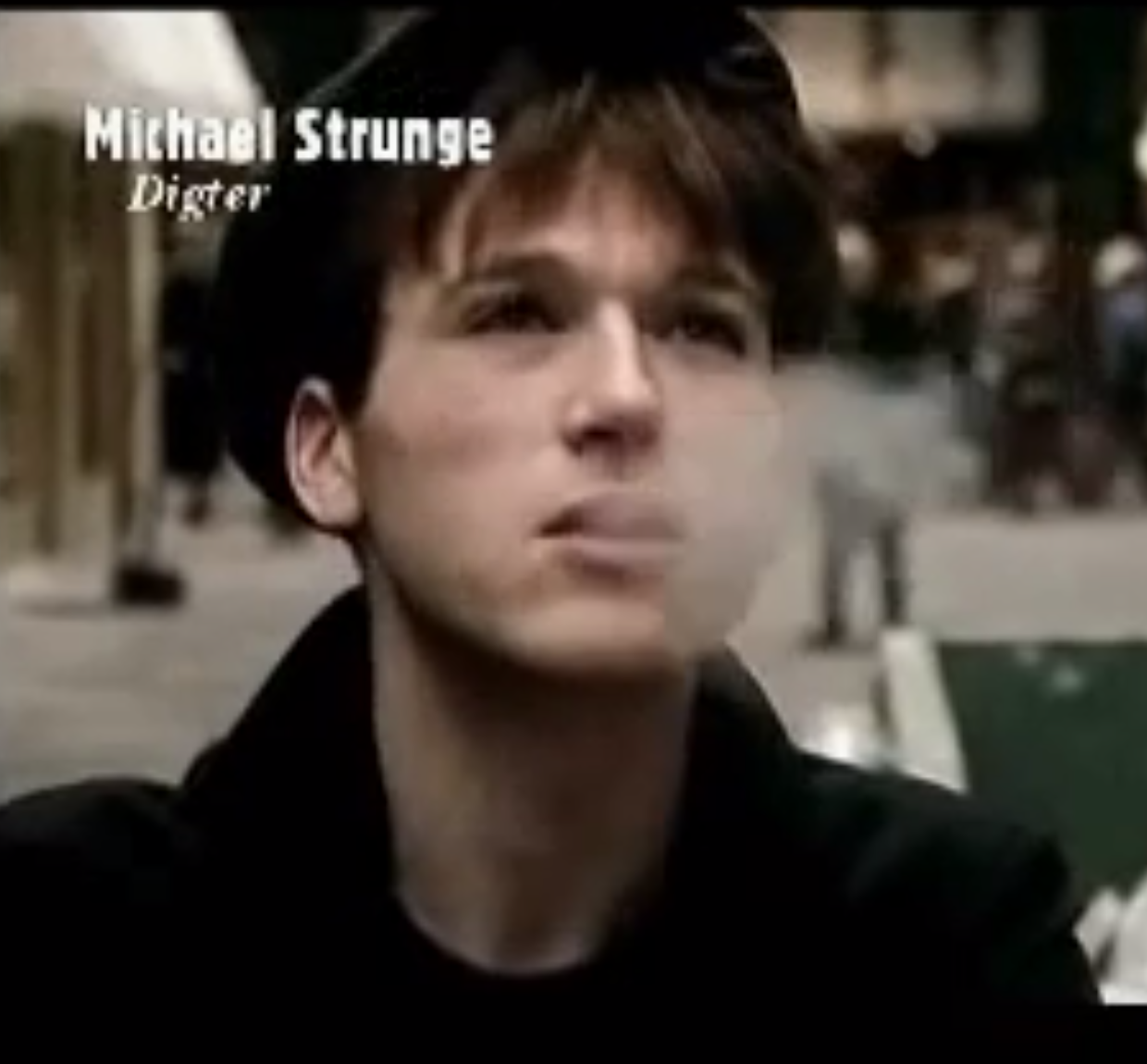
The final translation I'm presenting today is from the work of the quintessential New Wave post-punk poetic voice in Denmark, Michael Strunge, who died by suicide on March 9, 1986.


Posthumously, Strunge became the most popular poet in Denmark since Klaus Rifbjerg - and in contrast to the two first poets I've mentioned, Strunge was very much an urban voice in Danish poetry. Here is my new translation of his 1984 poem, "When we're asleep" from his collection Armed with Wings...


Note how in the poem the voice of the speaker originates from an apartment in the city and ends up encompassing all of the surrounding landscape. Strunge is far from the first poet to compare the hearts of lovers to a pair of birds - in fact Nis Petersen did exactly that in one of the poems in Nattens Pibere, where he wrote:

"Men tænk, om to mennesker vågnede midt
om natten og glemte, hvad mit var og dit
og sang — bare sang som hr. Kvirrevit
og fru Kvirrevit
kvirrevit!
vit!"

"Imagine two humans waking up one night,
Forgetting what was mine and what was yours
and sang — just sang like Mr. Chip-Chirip
and Mrs. Chip-Chirip:
Chip-chirip!
Chip!"

I'm not suggesting a direct intertextuality between the two misfit poets here, but for sure a commonality of theme and imagery.

As far as I can tell none of these Danish poets from three different generations have been translated into English before. I hope some will enjoy their work.

Monday, June 15, 2009

Translating poetry

During the long hiatus this blog has had I have mainly worked with a different type of blogging on a Tumblr platform. Under the title Ordinary Finds (originally intended as a companion to this blog's self-professed 'rarer finds') I have produced close to 5.000 posts - most of them visual rather than text-driven - mentioning important cultural figures from the fields of literature, art, film, music etc.

However, I have frequently experienced language problems when trying to disseminate knowledge about poets who didn't write in English and therefore have had their reputation in Anglophone countries largely depend on the quality of the translations of their work. Routinely I've come across language hampered by old-fashioned formulations, stiff meters, or melodramatic metaphors when looking for good versions of German Romantics or French Modernists alike. As a result I started producing my own translations for posting on Ordinary Finds and its more recent off-shoot Lumpy Pudding - whenever I felt that I was able to improve on the already existing work, or in extreme cases when nothing at all was at hand in English...
I thought that now I would take the opportunity to collect the work of this kind I've done more or less casually over the last 6 to 8 months. Here are seven of my translations from German, French and Romanian. The poets in question are Friedrich Hölderlin, Rainer Maria Rilke, Wolfgang Borchert, Lucian Blaga, Boris Vian and Hector de Saint-Denys Garneau...

~~~~~~~~~~~~~~

Recently my translation of one of Hölderlin’s best short poems, Hälfte des Lebens, was reprinted in the Stanford University program for their fifth Pan-Asian Music Festival - the occasion being the performance of Joji Yuasa’s setting of the poem for chorus and orchestra, entitled Cosmic Solitude… This event illustrates the importance of Hölderlin still: Japanese music, German Romantic poetry translated into English by a Dane, performed by a bunch of ‘Californians’ - good, no?

Hölderlin: One Half of Life

Hung with golden pears
and full of wild roses
is the land in the sea.
Your stately swans,
drunk with kisses,
dunk their heads
in the holy, sobering water.

Alas, where shall I take, when
winter comes, flowers,
sunshine,
and shades of the Earth?
The walls stand,
speechless and cold, in the wind
the banners rattle
.

.
Image - Markus Lüpertz: Ritter Hölderlin und Heine im Schwertkampf - Oil on canvas (The UBS Art Collection)

~~~~~~

Next, I felt the need to tackle Rilke's Herbsttag, which has been translated numerous times by high-level American poets - with quite miserable results. A web page conveniently gathers all the bad ones here...
.

.
Here's my take:

Harvest Day

Lord: it is time. The summer has been huge.
Lay your shadows across the sun dials,
in the fields let the winds run loose.

Command the last fruit to ripen;
give it two more Southern days,
force it to completion and chase
its last sweetness into the heavy wine

He who still has no house shall never build.
He who is alone shall be given short shrift,
shall read and write long letters, shift
and restlessly pace the lanes that skirt the field
watching as the leaves drift.

~~~~~~

I knew little about Wolfgang Borchert before encountering his birthday, but after a little reading I began to admire his political stance as well as his writings. I chose one of his simple poems to translate, but on Ordinary Finds I also posted a mini-bio and an excerpt from his anti-war manifesto, Then There Is Only One Thing To Do...
.

.
Wolfgang Borchert: Try to
Stand in the middle of the rain,
Believe in the blessing of the drops,
Cover yourself in its noise
And try to be good!

Stand in the middle of the wind,
Believe in it and be a child -
Let the storm enter you
And try to be good!

Stand in the middle of the fire -
Love this monster
With the red wine of your heart
And try to be good!

~~~~~~~

Shifting to Romanian poetry, which of course I have been introduced to chiefly by my wife Camelia (who many years ago gave me a trilingual edition of Blaga - which did not have English versions in it!), I quickly ran into problems whenever I wanted to research well-known Romantic or Modernist poets, since they were hardly ever translated into English - or if they were the translations were horrible...

Lucian Blaga was a particular favourite of mine, so I had to do two poems of his, one for OF and one for Lumpy:
.


Quietude

It is so silent all around me that I can hear
the moonbeams when they strike the windows.

Inside me
a stranger’s voice has come awake
singing of a longing that is not mine.

They say that those who died before their time long ago
with young blood in their veins,
with strong passion in their blood,
with strong sunlight in their passion,
will come,
come and live on
in us
those unlived lives.

It is so silent all around me that I can hear
the moonbeams when they strike the windows.

Ah, who knows in whose breast – once, in eternity
you, my soul, will play
on the soft strings of silence,
on the harp of darkness –
a choked-off song of longing and desire to live? Who knows, who knows?
~~~

The Light

The light I feel
streaming in my breast when I see you,
is that not a drop of the light
created on the first day,
that light which thirsts for life?

Nothingness lay dying,
as the impenetrable one, hovering alone in the dark,
gave a sign:
Let there be light!

An ocean
and a raging storm of light
arose in an instant:
a thirst for sins, desires, longings, passions
a thirst for light and sun.

But where did it go, that blinding
first light – who knows?
The light I feel
streaming in my breast when I see you – wondrous one,
may be the last drop
of the light made on that first day.

~~~~~~

While Camelia could certainly help me with the Romanian language (and I am grateful that she did), since it is her mother tongue - and while I have a pretty good command of German myself, the thought of translating from French (a language I have a somewhat troubled relation with) seemed utter lunacy... Still, it wasn't hard to see that a lot of the poetry I was interested in posting could use a bit of a face-lift, and I often managed with the help of pre-existing versions to streamline the texts I enjoyed...

Boris Vian was always a particular favourite:
.

.
I don’t want to croak
Without having known
The black dogs of Mexico
Who sleep without dreams
The monkeys with bare bums
Devourers of the tropics
The silver spiders
With nests stuffed with bubbles
I don’t want to croak
Without knowing if the moon
Under her false nickel-face
Has a pointed side
If the sun is cold
If the four seasons
Are really only four
Without having tried
Wearing a dress
On the grand boulevards
Without having looked
Into a sewer inspection-hole
Without having put my prick
Into some bizarre corners
I don’t want to end
Without knowing leprosy
Or the seven maladies
One catches down there
The good or the bad
None of them bother me
If if if I knew
That I would have the first of it

And there is also
All that I know
All that I value
That I know pleases me
The green depth of the sea
Where the strands of algae waltz
On the rippled sand
The baked grass of June
The crackling earth
The scent of the pines
And her kisses
Now here, now there
Her beauty obvious to all
My Bear cub, Ursula
I don’t want to croak
Before having used
Her mouth with my mouth
Her body with my hands
The rest with my eyes
I say no more, it’s better
To stay reverential

I don’t want to die
Before someone has invented
Eternal roses
The two hour work-day
The sea at the mountain-side
The mountain at the sea-side
The end of sadness
Newspapers in colour
All children happy
And so many gadgets still
Asleep within the skulls
Of genial engineers
Of jovial gardeners
Of civil citizens
Of urbane urbanites
And thoughtful thinkers
So many things to see
To see and to hear
So much time to spend
Searching in the dark

As for me I see the swarming
End arriving
With his lousy mug
Opening for me his
Bandy toad arms

I don’t want to croak
No Sir, no Ma’am
Before having explored
The flavour which torments me
The flavour which is the heaviest
I don’t want to croak
Before having tasted
The flavour of death.

~~~~
.
.
On the morning of June 23, 1959, Boris Vian was at the Cinema Marbeuf for the screening of the film version of his novel J’irai cracher sur vos tombes. He had already fought with the producers over their interpretation of his work and he publicly denounced the film stating that he wished to have his name removed from the credits. A few minutes after the film began, he reportedly blurted out: “These guys are supposed to be American? My ass!” He then collapsed into his seat and died from sudden cardiac death en route to the hospital.

~~~~~~~

Finally, my latest find, Hector Saint-Denys Garneau, the French-Canadian Modernist who died tragically young, and who seems to anticipate this fate in one of his poems:
.

.
Hector de Saint-Denys Garneau: Bird Cage

I am a bird cage
A cage of bone
With a bird

The bird in the cage of bone
Is death building his nest

When nothing is happening
One can hear him ruffle his wings

And when one has laughed a lot
If one suddenly stops
One can hear him cooing
Deep down
Like a small bell

It is a bird held captive
Death in my cage of bone

Wouldn’t he like to fly away
Are you holding him back
Am I
What is it

He cannot fly away
Until he has eaten all
My heart
The source of blood
With its life inside

He will have my soul in his beak

Sunday, July 20, 2008

It's a pink, pink, pink moon

All day I have been preoccupied with translation, and I have very much had Nick Drake's Pink Moon album on my mind. As many will undoubtedly know, the public fame of that album and its title song grew exponentially when VW decided to use it in one of their commercials, targeted specifically at an anti-commercial-watching segment of potential VW-buyers...

A long chapter of the 33 1/3-series volume on Pink Moon by Amanda Petrusich is given over to a very full description of the creative and commercial process behind the making of this particular ad, so one can go there for additonal info.

This, not very successful book carries a very pretentious blurb, part of which goes like this:

Like nearly all prematurely buried cult figures, Nick Drake is reinvented each time he is rediscovered. In 2000, the sheepish, astral musings of "Pink Moon" became synonymous with backing a Volkswagen Cabrio convertible away from a raucous house party, as VW boldly sold American drivers on the notion of eschewing red plastic cups and bro-hugs for moonbeams and tree trunks (and a cute German car - sort of). The Cabrio ad inadvertently sparked an unlikely boost in record sales, propelling the album towards platinum status nearly 28 years after its release. But with each well-intentioned revival of interest, Nick Drake slips further and further out of reach, martyred and codified, superceded and consumed by his own tragic context. Since his controversial death in 1974, Nick Drake has become: the 26-year-old prophet, the diffident enigma, the tortured precursor to Kurt Cobain, the fallen hero, the folksinger-as-folksymbol, the self-sacrificing patron saint of lonely, disaffected teenagers - the One who died for our sins.
For now, just watch:


Note how the commercial contrasts nature and a quiet communion with it (river, darkness, fireflies - and, of course - moon) with youth culture of the noisy, imbecilic kind (loutish, drunken and disorderly behaviour). This is a tricky sell: one community has to be valorized (we are not interested in lonely drivers here); the other must be connoted negatively. A strategy that helps accomplish this is to associate the essential features of the car with the desired community and its harmony with nature. The car's stream-lined design details and its almost noiseless swoosh as it glides through the land all become natural features: the tail lights are at one with other light sources: fireflies, moon glow; the in-car stereo produces harmonious sounds that only enhance nature's singing (crickets), and do not drown them out. The price for this is that the commercial has to conjure up a fantasy world: after all one cannot really listen to acoustic folk music in most cars, least of all with the top down!

The actual lyrics to Drake's song are, of course, not really very suited for the purpose of selling a cabriolet car - or any product for that matter, with the possible exception of Prozac. They are in fact quite scary and haunting, promising us that forces of nature will catch up with 'you', the addressee of the song, i.e. us all, and do away with us:
I saw it written and I saw it say
Pink moon is on its way
And none of you stand so tall
Pink moon gonna get you all
It's a pink moon
It's a pink, pink, pink, pink, pink moon.
The threat, revenge fantasy or prophesy spoken by these lyrics makes a lot of sense in connection with Nick Drake's own life, but clashes violently with the easy life and quest for peace and quiet of the young people riding the VW. The only way this can work is if our four friends in the cabrio can somehow be associated with the pink moon and its revenge on an other, unidentified party. This is accomplished through the film's timing of image and music, with the most aggressive part of the lyrics being sung just as the car pulls up in front of the house where the obnoxious party guests are already at it with their offensive, loutish behaviour. The VW drivers thus become allies with the pink moon in the future eradication of the louts... but for now they'll just drive on through the night, swooshing along to Nick Drake's whispered lyrics.

This use or abuse of a song that is basically a cry for help in order to sell cars has indeed offended many who were already fans of Nick Drake's music. On the flip side of that concern is the unquestionable fact that thousands of people who had never heard this music before began seeking it out because of the commercial. One testimony on YouTube captures the sentiment of several young people encountering Drake's music through the commercial:
I listened to all of Nick's songs, especially this one, when I drove from Atlanta to LA alone in my Alfa spider, the top down much of the way, most beautifully in New Mexico. For me, the commercial makes me yearn for those perfect youthful summers I never quite had, fresh aired freedom with lovely groovy girls and true blue friends and all of life's delicious possibilities rolled out before them. And who cares if it's a commercial. Copywriters and directors can be as soulful as anyone.
In a cultural studies vocabulary, this is the typical process of commodification and incorporation into the mainstream of a hitherto underground, or subcultural artefact or cultural phenomenon. The incorporation always comes at a price, but also opens up a potential space for usage of the product in new narratives, which themselves can still be subversive or un-incorporated...

This short analysis is one such narrative.