Showing posts with label Film. Show all posts

Monday, February 18, 2019

The Whitewashing of Unchained Melody

In late 1954, Russian-Jewish-American composer Alex North was putting the finishing touches to his score for a prison drama - a distinct type of B-movie fodder - titled Unchained. If you’ve seen the film, it’s probably because you’re either an insomniac addicted to the TCM channel, or because you’re a die-hard Dexter Gordon fan who has to have heard every performance he ever laid down. Gordon was, purely by co-incidence, serving a sentence for drug possession when the movie was shot on location in the California Institution for Men, a correctional facility in Chino, and he makes an uncredited cameo appearance as a saxophone player in the prison band.


This 1955 movie is one of those weird instances where a Hollywood script is based on a non-fiction book that tries to offer a corrective to the way mainstream America perceives a social problem - in this case the issue of incarceration and re-socialization of criminal offenders. Hall Bartlett, who started out as a documentary film maker, wrote the screenplay (spending six months living with inmates in a prison while writing it), and was both director and producer as well. He was clearly a man with a conscience and a message. He went on to direct better-known films such as Jonathan Livingston Seagull.

Bartlett was happy enough with North’s score to the movie, but reminded him that there needed to be a song in there as well. After all he had cast African-American operatic baritone Todd Duncan (the original Porgy in Gershwin’s opera Porgy and Bess) in the flick, and he had to have a song to sing. North had a melody in mind, and called up his Tin Pan Alley lyricist Hy Zaret to get him to pen some lyrics. Zaret was pissed off, because he had made plans to paint his house that day and couldn’t be bothered to churn out another set of trifling lyrics. North cajoled him into it after all, and the result was a song without a title, that we all now know as “Unchained Melody”. Heard outside the context of the prison setting that it was performed in in the film, it in fact sounds like any other love song from the dominant middle-class culture of the 1950s. The lyrics seem unconnected to the theme of the film, and the word “unchained” does not appear in the lyrics anywhere.

Bartlett was a bit miffed that Zaret’s lyrics didn’t spell out the social message, but the way Todd Duncan sang the song by turning it into a Lead Belly style blues/worksong manages to convey the right feeling of longing for freedom that brought the song in alignment with the sentiment of the film: “Long all you want, but don’t break out of jail before you’ve served your time!” In Duncan’s version we suddenly hear the word “time” in a different sense - that of doing hard time in prison, when he sings the lines “Time goes by so slowly, and time can do so much”… The effect is deepened by the blue, dropping glissando Duncan adds to the word “slowly”. In contrast he refrains from glissando on the word “love”, thus shifting the whole dynamics of the lyrics. Remarkably Duncan does not perform the song’s minor key bridge, which in all subsequent versions is a striking feature, enhancing the eerie mood of the song.


Duncan’s abbreviated version, accompanied only by acoustic guitar, lasts little more than a minute on screen, but still the song got an Academy Award nomination and almost won an Oscar. Harry Belafonte recorded a folky version of the song, retaining the simple guitar accompaniment, and also performed it live at the Awards show in 1956, but in the end it was pipped for the Oscar by Love Is a Many-Splendored Thing - incidentally another product created by a Jewish-American Tin Pan Alley song-writer. However, the vision of a black man longing for freedom from shackles and chains resonated in a much deeper way with black performers than even the Unchained film-maker had envisioned, and before the year of release of the film was over two very distinct black vocalists had hits with their versions of the song: Roy Hamilton and Al Hibbler. Both these performers have interesting trajectories in show business and in Hibbler’s case also in civil rights activism, as does a third performer who 5 years later recorded a version of Unchained Melody - Sam Cooke, whose posthumously released 1964 song “A Change Gonna Come” is one of the Civil Rights Era’s classic anthems and comprises the same theme of longing for escape and redemption.


Belafonte's folk version above; Sam Cooke's soul version below...


Each of these four black artists’ version of Unchained Melody added a particular subtext to the otherwise banal love song lyrics, but let's look more in depth at Hibbler's and Hamilton's. Al Hibbler’s version on Decca was officially recorded to tie in with the release of the film, and it owed quite a bit to Duncan’s version in spirit. Hibbler had had a long career as vocalist for Duke Ellington’s big band in the 1940s, and had been struggling to make the transition into solo success as a pop artist in the early 1950s. With Unchained Melody he struck gold. Hibbler was quite the character, often ridiculed for his over the top vocal quirks and idiosyncrasies. He was also a Civil Rights activist as early as the late 1950s which of course made him a problematic commodity as a pop star for record companies. It took the unlikely intervention of Frank Sinatra to ensure that Hibbler could keep recording via a contract with Reprise Records. Hibbler's later career highs include a spirited LP of primarily Ellington material recorded with free jazz horn player Rahsaan Roland Kirk in 1965, but not released till 1972. Perhaps these two, on the surface of things, unlikely collaborators were kindred spirits in more ways than one. Both artists were blind - Hibbler from birth, Kirk from the age of two…

Hibbler’s Unchained Melody is straight-forwardly delivered, with only slight quirks in his dwelling on the word “God” and adding a clear melisma on “to” in the fervently expressed wish in the lyrics “God speed your love to me”. The minor key bridge is rushed in nearly recitativo style, and there are bluesy inflections in phrases such as “Are you still mine?” and on the word “love” - and a vast vibrato effect on the final repetition of the word “me”.


Roy Hamilton recorded his version of Unchained Melody hot on the heels of Hibbler’s and it cashed in almost as well as Hibbler’s ‘official’ release did. Hamilton was a seasoned Gospel artist and he took Unchained Melody to church in ways that Sam Cooke may have listened to and emulated to an extent - not that Cooke hadn’t perfected the transition from gospel to secular music in his own career already. Hamilton recorded for Columbia Records' ‘pop label’, Epic, one of Decca’s main competitors in the multiple genres Unchained Melody participated in - easy listening, gospel, pop, r&b and country. Hamilton’s ace in the hole, vocally, was that he had a voice that could tackle the operatic scale of songs such as Unchained Melody, as well as the earthier qualities vocalists such as Duncan and Hibbler mastered really well. Hamilton’s golden period had started with his hit recording of You’ll Never Walk Alone, and in his eager search for follow-up material, he had stumbled over Unchained Melody. After a brief career in the spotlight, Hamilton ran into health issues (possibly TB) that led to retirement from performances. After several half-successful attempts at comebacks, he died in 1969 from a sudden aneurism in the brain and has lapsed into relative obscurity among music fans.

Hamilton’s nasalised baritone is fuller than Hibbler’s, and Hamilton’s lyrics inflections are on words such as “need” and “touch”, rather than “time”. His use of melisma on “slowly” and vibrato on “love” pull the version out of jail, as it were. This aspect of the song was later exploited more fully when The Righteous Brothers’ Bobby Hatfield recorded what most people consider the definitive version of Unchained Melody in 1965. Hamilton’s musical arrangement at first follows Hibbler’s closely in the use of bugles, but later deviates considerably by adding mysterious string effects to the arrangement of the bridge, where the strings emulate the pull of the waters mentioned in the lyrics. At the end a grand piano emerges from the arrangement and lends a clear gospel tinge to the closing.


The point of this small account of the under-documented early African-American history of “Unchained Melody” is to highlight the versatile Americanness of this song. It throws light on binaries that run through American cultural and identity history, but are often denied or directly debunked. Tin Pan Alley’s greatest song-writers were Jewish-Americans, their songs were often best interpreted by African-American performers who added their own meanings to songs about longings and hardships - and yet the relations between Jewish- and African-Americans were often fraught with racism and stereotypes on both sides. In this particular case, we have a song that was reclaimed by black performers as a text speaking to their shared experience of chains and confinement - despite the fact that the song was not written by an African-American its lyrics and melancholia spoke directly to that part of black identity. However, no sooner was the song reclaimed for black identity, than it was re-appropriated for the white teen market and thoroughly whitewashed by mainstream performers.

Most of the material of the “Great American Songbook” was created by first or second generation immigrants, who worked hard to fit in and realize their American Dream - a Dream that black Americans were debarred from for several decades longer than most other minority groups. Much of the musical material that was recorded and made popular by African-American performers was also quickly re-recorded by white artists, often with more commercial success than the originals. This is obviously also the case with Unchained Melody. Contemporary with Hibbler and Hamilton’s versions, several whitewashed version circulated with great success, including a largely instrumental one by Liberace, a full orchestral and choral arrangement by Les Baxter’s Orchestra, and a strange bolero-tempo version by June Valli which reverses the gender dynamics of the song.

No success with Unchained Melody, however, has been greater than the one scored by Bobby Hatfield in 1965. His arrangement of the song scrubs it completely of its origins as a black man’s prison lament. It’s a white-bread love song by then. The musical changes to the arrangement and the unusual original structure of the song made in The Righteous Brothers’ version contribute to mainstreaming the song into a jukebox hit about teenage love. Hatfield uses excessive melisma on almost every word from the first line of the song, and adds vocal contortions and vibrato to the chorus and to the minor key bridge. He even puts a glissando from the word “me” over into an added “yeah” at the end of the bridge. The pathos of the song is underscored by the march tempo used by the orchestra, and the swelling effect of adding more and more instruments and a choral accompaniment after the bridge.


For the nostalgia market, this version of the song was used in one of the ultimate 1990s love stories, the Patrick Swayze/Demi Moore movie about unattainable love after death, Ghost, sealing the Hatfield version’s evergreen status. The duo also re-recorded the song and for a few weeks bizarrely had two versions of the same song in the US charts. Coincidentally, another use of Unchained Melody in a movie soundtrack occurred the same year when the 1963 novelty/ white doo-wop version by Vito & the Salutations was featured in the gangster movie, Goodfellas… These recontextualizations of Unchained Melody removed the song from its original meaning, and made its cultural expression more universal, but also much less specific - and completed its whitewashing.

Elvis Presley, who had whitewashed a fair bit of black material in his younger days, was a late-comer to Unchained Melody, but managed to record it immediately before his death. His version paradoxically brought back some of the gospel elements Hatfield had taken out, which is especially audible in Elvis’ live TV-version of the song from Cleveland Auditorium in 1977. The footage is strangely ghostly, as an overweight and obviously ill Presley huffs and puffs his way to the piano, only to belt his soul out when the song starts. Once again Unchained Melody becomes associated with impending death in the listener’s mind. Presley brings in much the same orchestral arrangement as The Righteous Brothers’ used, but his use of grand piano takes us right back to Roy Hamilton’s gospel elements, and Elvis’ hiccup at the end of the word “God” (on two separate occasions, so clearly by design) is very reminiscent of Hibbler’s vocal tic at the same point in the lyrics. By odd coincidence, Elvis had met Hamilton shortly before Hamilton’s death in 1969, while they were both recording in the same Memphis studio, both being produced by Chips Moman. Elvis was a long-time fan of Hamilton, particularly his gospel recordings. When Elvis finally tackled Unchained Melody 8 years later he, in a manner of speaking, synthesized the versions that had come before and fused black and white vocal influences together in an all-American version of the song.


However, Unchained Melody never could become reclaimed as black again, despite Elvis, and despite the 100s of versions recorded later. This story is in no way atypical of how music was disseminated and consumed in the US in the 1950s, 60s and 70s where radio play, sales distribution and audiences were still to a large extent racially divided. It’s still remarkable that the early black recordings of Unchained Melody all had cross-over appeal and were enjoyed also by white audiences, and still the song ended up so whitewashed that few now know the African-American portion of its history.

Tuesday, May 20, 2008

A Skin Too Few

Jeroen Berkvens' 1999 documentary A Skin Too Few takes its title from a remark Gabrielle Drake has often made about her brother Nick, trying to describe why he found it so hard to cope with the world. This film is everything other Nick Drake documentaries are not - a raw heart-tugging document of a young man's terrible trouble adjusting to the pressures of growing up, being uncommonly talented and unreasonably sensitive at the same time. The film shows testimony from family and close friends and associates, illustrating Drake's slow turn away from the world into his own mind where demons of depression lurked and eventually overpowered him.

Unlike Nick Drake Under Review this film does not rely so much on assessments from other musicians or journalists/biographers. In fact the only other musician we hear from is Paul Weller whom we see in the opening scene in a recording studio w. John Wood and Robert Kirby, two of Drake's very close collaborators. Weller never knew Drake, nor does he have much to say about him, so I wonder why he has to appear at all, but never mind...

Rather, we should be very grateful for what we get from this film instead: a very moving portrait of a man and an artist who was very deeply rooted in a loving, supportive environment, both in terms of family and friends and his fellow professionals in the music world. We follow Drake's life chronologically, virtually from cradle to grave, and the main narrator of this story is his older sister Gabrielle, supplemented by the taped voices of both Rodney and Molly, their parents, telling us of events that Gabrielle did not herself witness.

It is quite interesting to get the whole story of the Drakes' time in Burma and to hear Gabrielle speak of Nick's birth and the easy life of a colonial well-to-do family in the late 1940s - illustrated by home movies of a happy family. Her assessment of Molly as a troubled soul, buoyed up by the love of her husband who made life livable for Molly without strangling her creativity is very poignant. The footage then takes us to Tanworth-in-Arden and inside the magically named childhood home of Nick, Far Leys, where we follow the camera into Nick's room, see his wonderful round window, while the soundtrack plays a home recording of "Hazey Jane I" (in a much more rocking version than the Bryter Layter version - a very cool performance by Nick), the camera then panning to a view of a fruit tree out of the window. The images thus already prefigure the theme of home, longing, escape, failure, return, sadness which structures the whole narrative of the film.

Gabrielle then plays one of Molly's songs, again emphasizing the very strong relation between Molly and her son, both in terms of the similarities of their temper and talent, and in terms of her maternal love. Over the sound of Molly's song we hear the train clickety-clacking, signalling Nick's departure to Cambridge which is the next period to be narrated by the film. The use of the train in image and sound is another unifying feature of the film, recurring throughout...

Brian Wells, a Cambridge friend of Nick Drake's, narrates the next portion, a story of dope smoking, guitar playing - in effect a 3 year holiday for the young men. In contrast, Gabrielle reads from a letter from Nick to his parents on liking Cambridge more than before, claiming to have "thrown off one or two rather useless and restrictive complexes that I'd picked up before coming here". One of course wonders where and when...? Gabrielle's stock of letters from Nick would certainly be superlative material for a sincere biographer to have access to. "River Man" is played over footage of Cambridge streets - people coming and going as the lyrics also detail. On tape Rodney speaks of Nick's Cambridge nostalgia, and of his desire that Nick should have a degree as a safety net, whereas Nick insisted that that was the one thing he would rather not have...

The scene shifts to London as Gabrielle remembers Nick one day coming home to their flat, tossing copies of Five Leaves Left on the bed - to her amazement, since she never realized that he was recording a whole LP. This portion continues with musical testimonials from producer Joe Boyd talking about Nick's skills and reliability as a player, Robert Kirby speaking of his arrangements ('lonely and bleak') complementing the perfect guitar line, which John Wood, the engineer, illustrates on the mixing board (playing the raw tracks of "Chime of a City Clock"). As the song plays on the soundtrack in its fully finished version, the images illustrate the song with night footage of rainy London street, segueing into the well known stills of Drake standing motionless against a wall as other pedestrians rush by.

Next, Boyd talks about Nick quitting touring in frustration over audiences being indifferent or hostile. Wells tells an anecdote about Nick slipping into isolation and depression. One of his most upbeat songs, "When Day Is Done", illustrates Nick's next move "back where you've begun," as the lyrics read. Wells remembers Nick returning home to Tanworth, and his being ashamed at having failed to live and cope in London. Drake was hospitalized, and diagnosed as clinically depressed, whereas Wells sees Nick's condition more as an existential crisis, brought on by the coldness and futility of life as such.

We next hear a recording of Molly, quoting Nick: "I don't like it at home, but I can't bear it anywhere else..." Molly concludes that Nick had "given up on the world", and she recalls her utter inability to help him overcome his sense of acute failure at everything he had ever tried to do. Gabrielle explains it like this: "I never did see a change - it crept up on us..." "He saw more, and he became more silent as he saw more." "That is expressed in his songs and almost nowhere else..." This sequence of the film is very dark, also in terms of images of the night, storms, even featuring Gabrielle dressed in black - all quite effective emotionally, as one understands the tragedy of his family not being equipped to help Drake at all. Love was not enough.

Boyd talks about trying to get Drake to seek help from a psychiatrist, but Nick being ashamed of such a course of action. Later Boyd details Nick's outburst against his lack of success, making an analogy between Nick's anger directed towards Boyd, and the lyrics to the song "Hanging on a Star" ("Why leave me hanging on a star when you deem me so high?") As Nick sings the desolate lyrics to "Know": "Know that I love you, Know I don't care, Know that I see you, Know I'm not there" we pan to the supernatural beauty of the English woodlands in misty, early morning shots, another technique Berkvens uses to great effect, showing the incongruousness between Nick's surroundings and his self-image.

Keith Morris, photographer for the Drake albums, remembers the Pink Moon sessions, especially Nick's almost total silence which contrasts dramatically with earlier occasions where they had worked together. The images taken during that session are shown with no musical accompaniment. The film shifts to Gabrielle reciting Molly Drake's poem "The Shell," describing how both Molly and her son had problems sensing the world directly without the feeling of being imprisoned in a shell - this is accompanied by images of Gabrielle placed in the woods as a stylized, tragic figure herself - obviously practising her actor's craft here...

We are next treated to English woodland and village scenes - evincing the same stylized beauty, as Drake finally sings "Hanging on a Star". The camera takes us again to Nick's room, and a montage of both parents' voices narrates the last night of Nick's life (we see Nick's round window increasingly freeze over during this narration). Molly remembers the final night and next morning - the agony of never having known how dangerous the Triptozol pills were, the inevitability of finding him dead that morning. Gabrielle remembers being in a comedy play in Bristol at the time, and how her parents drove down to tell her of Nick's death. As she tells us this, we see the room scene again, and Berkvens uses the out of the window motif, as Nick sings of the "endless summer nights" (from Pink Moon's "From the Morning"), escaping his shell for good.

Gabrielle's theory of Nick's death is that it was a spontaneous act - whether suicide or cry for help she could never determine... (We see the interior of the Tanworth-in-Arden church as a service ends.) Gabrielle muses on the blessings of having had such a family and the tragedy of losing them. Kirby relates his feeling of being shocked at the news of Drake's death, whereas Wood felt terribly sad, but not surprised...

The closing scene begins with Nick's voice on tape, apologetic that his voice is failing - but he promises to do one more song. Over images of Tanworth "Northern Sky" plays, and suddenly the music is lowered so we hear Nick's naked voice, as we see his headstone in the church yard. The sequence ends with an impossibly beautiful shot of the church in the distance.

Gabrielle closes the film by talking of Nick's recent fame, and the helping quality of Nick's music for so many young people of later generations ("had he only known..."). As "Northern Sky" closes, we end with the Drake family home movies - filled by images of Nick's happy childhood. The soundtrack ends with sounds of waves and moving trains.

I find the film very well made, especially as it allows itself to have a narrative that veers from the straight documentary aesthetics and into techniques borrowed from fiction: the use of leit motifs, colouring, sound effects etc. This enhances the film's emotional impact greatly and it is hard to not be very moved by its otherwise familiar story. I am very impressed by Gabrielle Drake's role in the film which she virtually carries single-handedly - both as a trustworthy narrator and as a great actress using her craft to play on our emotions. The 48 minutes spent with the Drake family are very enriching and enlightening.

Monday, May 19, 2008

Nick Drake Under Review

A few weeks ago my friend Gorm was visiting and spotted a couple of Nick Drake documentary DVDs on my shelf. I had been saving them for special occasions because I knew they would be emotionally challenging to watch and I would want to write about them (as this review bears witness to), and at the same time I hadn't really wanted to watch them for fear of disappointment - the usual syndrome that can hit the ardent fan when someone else dares to provide opinions on and analyses of the sacred object: On the one hand you want there to be as many Nick Drake documentaries as possible, but on the other hand you don't want to watch them because you know they'll be full of nonsense... Anyway, Gorm asked if my wife and I had watched the films, and when I said no, he concluded: Oh, you're not that big a fan, then! Thus challenged, I figured it was high time to actually get started and to deliver the review I rashly promised when I first started this blog named after a line in a Drake song...

The 90 minute Under Review film came out on DVD in 2007 (Chrome Dreams - Director and writer apparently both wish to remain nameless...). It is not sanctioned by the Nick Drake estate, Bryter Music; nor by Drake's record company, Island. Therefore, we are only treated to short snippets of Drake's recordings - I suppose to keep the copyright issues minimized by sticking to the standard fair use clauses. As a result the film contains longer clips by Bob Dylan and Davey Graham than it does by Drake. Of course there is also the matter of Drake never having been filmed live, so we don't get any performance footage either, but then that is a given in any Drake film.

What we do get is a bunch of interviews with people whose lives have in several ways brushed up against Nick Drake's, either because they knew him, or because his music somehow has captivated them. The film is chronological in that it follows Drake's life from childhood to his premature death at 26. It goes into great detail about some aspects of his life, primarily of course the creation of his three completed albums, but also to some extent his personal life. The interviewees thus function as narrators taking us through a mixture of basic information (although a voice-over narrator also provides that type of continuity, esp. in the first third of the film) and personal assessments. The chief narrators of that kind are the two main biographers of Nick Drake, Patrick Humphries and Trevor Dann, plus the only contemporary music journalist who took Drake seriously, Jerry Gilbert (Gilbert conducted the only interview Drake ever gave to a music journalist). Analysis is also provided by Caitlin Moran - columnist and journalist w. The Times, and her husband Pete Paphides - also a music journalist. They represent the younger voices, sanely assessing Drake's significance to our current time and its musical and cultural climate.

The second type of narrators consists of musicians, and again we get two different generational viewpoints: Drake's contemporaries and our contemporaries. Of the first kind are Fairport Convention musicians such as Ashley Hutchings (who 'discovered' Drake) and Dave Mattacks (who played on the Bryter Layter recordings w. Drake), as well as Ralph McTell - who headlined the last gig Drake ever played at. These three provide insightful analysis of why Drake failed as a live performer, but succeeded as a songwriter and musician in the studio. Other older members of the 60s folk scene in the UK are interviewed as well, but good people such as John Renbourn (who teaches us the difference between the blues style vs. the finger picking style on the acoustic guitar) and Robin Williamson of The Incredible String Band didn't really know Drake personally and have little to say about him. Here one sorely misses Linda and Richard Thompson, John Martyn and other, closer, musician friends of Drake.

The younger generation of musicians is represented by one of the relatively few women in the film, Kathryn Williams, who also performs fragments of Drake's songs. Keith James, a singer / songwriter in his own right, also performs covers of Nick Drake songs (some of which he has recorded on CD) and talks about Drake's tuning and playing techniques. A few comparisons are made with another English guitar innovator, Davey Graham, who has been rather more unkindly treated by time. Renbourn and Bert Jansch are of course also mentioned as influences on Drake's playing style, but other than that most of the film's interviewees emphasize strongly how Drake's music really transcends the narrow bounds of the 'folk' label, esp. because of his knowledge of other types of music, classical as well as jazz. As for the analysis of the music of Nick Drake the film is severely hampered by the lack of involvement from the people who really worked with Drake: Joe Boyd, John Wood, Robert Kirby - producer, engineer, arranger of scores, respectively, are all missing as voices...

The final type of interviewees consists of friends and acquaintances, and here we only really get snippets from an elderly couple who knew Drake's parents (but have nothing of interest to say) and a substantial contribution from Jeremy Mason - Drake's old friend (he wrote "Three Hours (to Sundown)" about Jeremy). Mason provides a number of rarely seen photos and lets us see some of his own drawings of Nick - great material, much of which stems from a stay the two of them had in Aix-en-Provence, France. Again, though, one misses more testimonials from (other) friends (where are the women who knew Nick?) and family - but Drake's parents are both dead and his sister Gabrielle is reluctant to talk to most journalists and biographers...

This leads me to my main bone of contention with the film - the role of Trevor Dann. I intensely dislike his bio of Drake, Darker Than the Deepest Sea, which spuriously suggests that Drake's problems all stem from childhood abuse of some unspecified sort (all based on so-called textual analysis of Drake's lyrics). While Dann doesn't voice any such views in this film, he still comes across as a very unsympathetic and snide character who routinely ventures into territory he has little knowledge of. His casual references to Drake's allegedly excessive drug use are left unchallenged by the film makers, whereas many of Drake's friends are willing to testify that these stories are vastly overstated. Further, it quickly becomes clear that Dann is in deep waters himself when one hears him waffle about the role of modal jazz as an influence on Drake, or - even worse - his muddy explanations of the so-called Blake and Tennyson influences in Drake's lyrics (Dann refers to the authority of so-called "lit crit guys", of which he himself admittedly is not one, to back this claim up, but he doesn't provide one specific example). Dann also claims an influence on Drake by James Lovelock's ecological ideas, despite the fact that Lovelock's book Gaia - A New Look on Life on Earth was not published until 1979, 5 years after Drake's death...

Patrick Humphreys comes off as a much less conceited biographer and wisely sticks to contributions of a musical and cultural nature, but as sources go, it is really Jerry Gilbert who is the most interesting narrator and analyst. The film is therefore, on the whole, informative and sober, and it may function well as an introduction to Drake's work and parts of the late 60s, early 70s folk scene in Britain. For the hardcore fan of Drake there is less of interest in the film, and little that one hasn't heard already. The aesthetics of the film can get quite annoying, particularly in the choice of images to accompany the short musical interludes. This footage is invariably bucolic in the early 1960s instances and then gets increasingly political and social as we enter the 1970s - but what is worse is the plodding literalism of the images: when Drake mentions food in his lyrics, we see food; when he mentions a fruit tree, we see rotting fruit; when he mentions the sky - you've guessed it...

Overall, I would recommend that even fans watch the film, but the experience is not really very deep, either emotionally or intellectually. One doesn't get under the skin of Nick Drake - and perhaps that is all for the best...

PS: As a "lit crit guy" I cannot resist mentioning that when Drake's first band (while he was still in school) took the name The Perfumed Gardeners, they were referencing an Arabic erotic classic: The Perfumed Garden, translated by Richard Burton (Sheikh Nefzaoui was the original author). Not much has been made of this curious fact, and I suppose Nick Drake's role in choosing the name is not quite clear. One wonders, though, what the reading of such a book (basically an erotic manual) might have done to a young boy's imagination... Drake's life of the mind certainly still remains largely uncharted, despite much biographical writing and documentary film making.

PPS: Make sure not to miss the extras features, in particular Robin Williamson's tarot reading of Drake's "Character - inner and outer". It is wonderfully 60s, whacked-out hippydom, yet strangely sane and a bona-fide analysis of Drake as a person, bound in a specific time and milieu...

Monday, April 21, 2008

Everybody's Talkin'

I have a lasting fascination with American music from the 1960s. Many of the marquee songs of the era have become short scriptures for a generation of young folks who wanted change (hey Obama, you think you're so original?) and new values to believe in... Next semester I'll be teaching a short elective where I'll use a great book by Philip Beidler as the textbook - and he uses that phrase "Scriptures for a Generation" as his title, indicating that texts function ritualistically and communally in an orally transmitted culture...

Many such songs are 'auditory icons' in the sense that they are associated with specific filmic images through their use in film soundtracks. Think The Graduate, and hear Simon & Garfunkle's "Mrs. Robinson". Think Harold & Maude, and hear Cat Stevens' "If You Want to Sing Out". Think Midnight Cowboy, and hear Nilsson sing "Everybody's Talkin'"...

But wait a minute. Most Danes who hear "Everybody's Talkin'" these days will be thinking SAS, as in Scandinavian Airlines, because the corporate geeks in advertising have pinned their hopes on lifting the dwindling fortunes of the venerable inter-Scandinavian aviation conglomerate on the charms of this little ditty. The commercials give me vertigo (never a desired effect for an airline) and an acute sense of dislocation (not good either when destinations matter). The malady I am suffering from is space-time compression, a side effect of globalization: any text can nowadays be lifted from its original context and re-injected in a new sphere, worlds and decades from the origin. Mild disorientation usually ensues in individuals who know the history behind the original usage...

The lyrics of the song which make nice sense in the context of the film Midnight Cowboy, detailing the futile dreams of escape of two misfits trying to get out of New York City to soak up some rays in Florida, make somewhat less sense in the commercial, which follows a suited businessman as he wafts through check-in, security, arrival and apparently steps straight off the plane and into a sidewalk eatery in Southern climes... Listen:

Everybody's talking at me.
I don't hear a word they're saying,
Only the echoes of my mind.

People stopping staring,
I can't see their faces,
Only the shadows of their eyes.

I'm going where the sun keeps shining
Thru' the pouring rain,
Going where the weather suits my clothes,
Backing off of the North East wind,
Sailing on summer breeze
And skipping over the ocean like a stone.
Read into a contemporary airport/travel environment the first stanza describes a certain recipe for disaster for the business traveller: acute disorientation, borderline catatonia - you'll never make it to the gate on time... Second stanza: uh-oh, trouble at security, the sunglassed guards have obviously sussed that you feature on every no-flight list known to man... Bridge 1: not exactly the hassle free dream destination depicted in the film, where our business traveller hasn't even packed a cotton-coat, let alone any rain gear... Bridge 2: forgettaboutit - you'll never reach your destination at all - the plane is crash landing on water, Mayday, Mayday...

OK, so the advertising company didn't really pay attention to the lyrics they picked - what they wanted were the feel-good vocals and the sing-along tune. Never mind the queer undertones of the original film, never mind the frustrations and alienation captured in the song's mini-portrait of its dishevelled urban cowboy persona... In the SAS fantasy world we are all wealthy, male professionals jetting across our little uniform globe in safe, sanitized aeroplanes that never have their wheels falling off on landing...

Back to the 60s. Nilsson's versions of the song are in themselves a little strange. Here is the original opening sequence of the film, where soon to be male prostitute, Joe Buck (played by Jon Voight), prepares to get out of Hicksville:


Note the bizarre nasal drone and Roy Orbison falsetto imitation at ca. 2:00 till coda... Now compare with Nilsson's slightly longer hit single version, here recorded for a Beatsploitation Hit-Parade TV-show called Beat Club:


Note the distinctly queer moves Nilsson puts on, attempting a bit of snazzy finger-snapping and hip gyration at ca. 1:00. The foghorn-like moaning comes in the vocal effort already at 1:15 and is redoubled at the coda, where the circular wrist motion also gets a bit out of control... By this time Nilsson was enjoying a mega-hit with the single which had almost transcended the three-Oscar success of the film. Both these versions are cool mementos of an age where music and films like these could enjoy block-buster success.

Nevertheless, there is an even cooler person behind the song "Everybody's Talkin'": the original songwriter, Fred Neil... Compare the Talkin'-light tones with string arrangements of Nilsson's versions to Neil's own stark folk instrumentation, cool guitar solo and deep vocal delivery:


That is a scripture for a generation, folks... Neil was a songwriters' songwriter, having even a master in his own right, Tim Buckley, cover another classic signature song of his ("Dolphins"). For a while in the mid-60s Neil was a powerful presence in the East Coast folk scene, much admired by diverse figures such as David Crosby and John Sebastian of Lovin' Spoonful fame.

Sadly, Neil never made it big as a performer and, after a spell of living in Woodstock, eventually elected to make his own getaway to Florida, quit the music business and slip into obscurity. His life and times are meticulously chronicled at this website. As usual Richie Unterberger has done some of the best musico-cultural archeology on Fred Neil, which can be read in part in this excerpt...

Here is Richie's take on "Everybody's Talkin'":
Fred Neil [the album] is best remembered, however, for the original version of "Everybody's Talkin'." Much slower and more simply arranged than the famous cover by Nilsson, it clearly laid out his wishes to escape the madness of contemporary life -- the city, perhaps, or the music business? -- into a hermetic paradise. (That destination is most likely Southern Florida, where Neil would spend much of his post-1970 life, given the line about going to a place where the sun always shines through rain.)
In 2001 Fred Neil passed away at age 65, after a long battle with skin cancer...

Here is how "Everybody's Talkin'" ends, long after the SAS commercial is over:
I won't let you leave my love behind...

Tuesday, April 1, 2008

Cool Numbers

Math has probably never been cooler than it is right now. This is caused by the usual cocktail of money and image/exposure. Two geeky manifestations support my claim...

Lately, more popular science books on maths related themes than ever before have begun to appear. I know because my wife likes to read this type of thing, so I pick them up at airports and similar places. Barry Mazur's Imagining Numbers (Particularly the Square Root of Minus Fifteen), John D. Barrow's The Book of Nothing, Robert Kaplan's The Nothing That Is: A Natural History of Zero, Brian Clegg's Infinity: The Quest to Think the Unthinkable to name but a few.... Amazon literally provides dozens of similar titles.

Now even more focused and specialized phenomena have become the topic of 'biographies' in this vein. Where Zero and Infinity seemed the dynamic duo, the Robin and Batman of the previous generation of popular math books, the new protagonist superheroes are the Prime numbers. Partly, this is due to the publicity afforded quite esoteric matters such as the Riemann Hypothesis and other conundrums in math since the Clay Mathematics Institute offered a million dollars for the solution of each of seven big problems in math that had so far resisted proof, including the Riemann.

So far, the most publicity has gone to a rather obscure and eccentric Russian mathematician, Grigory Perelman, who seems to have dealt with the so-called Poincaré Conjecture, although it may turn out that adjudicating whether proposed solutions are truly valid or not may not be a trivial thing. Certainly I cannot quite figure out if Perelman has been given his million yet - or even wants it (he did get the so-called Fields Medal for his work but declined the award )... The BBC has a somewhat poppy video on this.

Back to the Riemann issue. This problem has to do with the frequency and distribution of prime numbers in the list of integers or whole numbers. It seems indisputable that there are proportionally more primes among the lower numbers in this infinite list, but what one cannot really prove is that despite the fact that there are fewer primes among higher numbers there will never be a point on the list where the last, highest prime is located. One assumes that there will never be a final prime - but can this be mathematically proven? This is not in itself a particularly sexy problem, and it doesn't even seem to be a problem whose solution will automatically generate a lot of practical advantages in the form of patents, products or other money-making propositions...

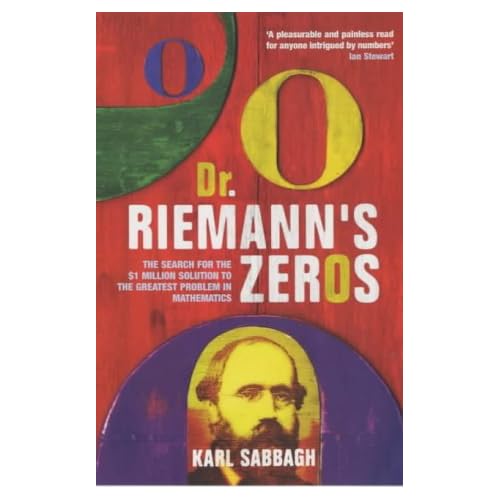
Despite this, the Riemann hypothesis has generated at least 5 popular books after the announcement of the Millennium problems: John Derbyman's Prime Obsession: Bernhard Riemann and the Greatest Unsolved Problem in Mathematics; Marcus Du Sautoy's The Music of the Primes: Seeking to Solve the Greatest Mystery in Mathematics; Dan Rockmore's Stalking the Riemann Hypothesis: The Quest to Find the Hidden Law of Prime Numbers; Keith J. Devlin's The Millennium Problems: The Seven Greatest Unsolved Mathematical Puzzles of Our Time; and Karl Sabbagh's Dr. Riemann's Zeros (apparently also published as The Riemann Hypothesis: The Greatest Unsolved Problem in Mathematics)... One notes that most of these titles try to sex up the subject by borrowing terminology from best-selling genres: Detective novel: "Unsolved mystery!" True crime: "Stalking!" and Romance: "Quest to Find!"

I only have one of these books, Sabbagh's volume, and my comments therefore only really specifically address his book. His prologue is illuminating: It starts with a comparison between popular anthropology books and books about mathematicians, the premise being that math geeks are also an exotic tribe whose behaviour can be very exciting to follow from a safe distance comfortably seated in your armchair. The Trobrianders, the Nuer and the Geeks, same thing: foreign languages, bizarre rituals and social customs, uncharted sex lives... This is of course familiar territory from other popular representations of math geeks: John Nash, the schizophrenic real-life protagonist of Oscar-winning film A Beautiful Mind (and the less-known Gwynneth Paltrow-vehicle Proof, which follows his daughter's problems with her father's legacy), is the most prominent case in point.

Sabbagh then moves on to anecdotes about how kids choose the math-path at a very early age and through all their stories talk about their considerable persistence, tenacity and stubbornness is following their calling. This rather makes math whiz-kids sound like missionaries and similar zealots. Again the attraction lies in the extraneous narratives rather than in the actual math. Sabbagh's book inscribes itself in the life writing genre in this portion. Many of the points the mathematicians Sabbagh has spoken with make have to do with exactly the intersection between math and their lives, such as the professor who thinks that the most remakable thing about his turning 60 is that that number is wedged between a twin pair of prime numbers: 59 and 61.

The first chapter of the book gives an intro to prime numbers and to the history behind Riemann's fascination with them. Again the most interesting part of the chapter consists of interview snippets from Sabbagh's encounters with mathematicians. My particular favourite is the Japanese professor, Yoichi Motohashi, who loves primes because of their 'tactile' quality:

In mathematics most things are abstract, but I have some feeling that I can touch the primes, as if they are made of a really physical material. To me the integers as a whole are like physical particles.
Motohashi is not only an essentialist who believes in the mysterious presence of some signs - in effect playing the same mythological role as words in the Adamic language which captures the innermost essence of that which it names - but also ignorant of etymology: After all integer means exactly 'untouchable' (teger comes from the Latin tangere, to touch). Good luck, Professor Moto, touching the untouchable!

OK, by the end of chapter one I began losing interest in Sabbagh's book, proportionally with the amount of specific math content growing, relative to the anecdotal material diminishing. I suppose the prime (time) stuff (i.e. anecdotes) became fewer and further between as the amount of ordinary integers (math for math geeks) increased... I'll leave the rest of Sabbagh for sleepless nights.

My other manifestation of geek cool of course comes from the media sphere. I've already mentioned how hunky Gladiator star, Russell Crowe, became mentally ill math whiz, John Nash, in the award-winning biopic A Beautiful Mind. Life writing again - we need to know what makes the freak tick and the woodwork squeek. It used to be that tortured geniuses a la J.D. Salinger came primarily from literature, or philosophy (Ludwig, oh Ludwig), or music (Ludwig, oh Ludwig), but now there is a new type of geek in town.

The latest and most fun example of the cool geek is the TV-series Numb3rs which features two math superstars on its roster. One is the cool (but geeky) type, Charlie Eppes, played by David Krumholtz. CBS provides this character info for him:
Charlie Eppes, professor of mathematics at a Southern California technical university, uses math to help his brother Don solve perplexing crimes for the FBI. Charlie is wary of people and enthralled with objects...
His geeky (but cool (well, sort of) sidekick), Dr. Larry Fleinhardt, played by the inimitable Peter MacNicol (almost reprising his brilliant character from Ally McBeal) gets this rap sheet:
Dr. Larry Fleinhardt, Charlie's friend and colleague, urges him to focus his attention more on his math studies than on FBI business. A brilliant physicist, Larry is awkward in social situations...

These two have seriously sexy, big brains but aren't much to look at in the conventional sense. Yet they drive the humour of the show, rendering the actual FBI-stuff involving shooting, stalking and capturing the bad guys relatively secondary in this 'crime' series. The show's motto also downplays the police procedural aspect:
We all use math every day; to predict weather, to tell time, to handle money. Math is more than formulas or equations; it’s logic, it’s rationality, it’s using your mind to solve the biggest mysteries we know.
Geeks thus rule rationality through formulas whose application invariably and logically leads to the necessary clues that solve the equations and then the crimes. Psychology, philosophy, medicine have all had their heyday as auxillary disciplines in detective shows, but now math has finally reached its prime!